An Ahrefs study of 14 billion web pages delivered one of the most uncomfortable statistics in digital marketing: 96.55% of all web pages get zero organic traffic from Google. That is nearly every page on the internet, invisible in search results. In Nigeria, where most business websites were built for appearance rather than performance, the number is likely even higher.
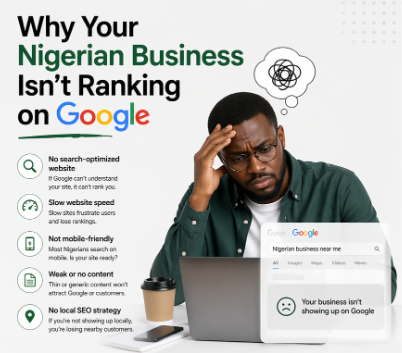
If your Nigerian business is not ranking on Google, you are not alone but you are losing customers every single day to competitors who figured this out before you. This guide identifies every significant reason a Nigerian business website fails to rank, with the data to explain why each one matters and the precise fix for each.
| DATA POINT: Nigeria had 107 million internet users in January 2025 with penetration hitting 50.58% by November 2025 (NCC/DataReportal). Over 84% of that traffic is on mobile. Your customers are searching on Google right now. The only question is whether they find you or your competitor. |
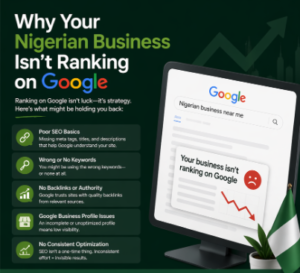
Reason 1: Your Website Is Not Indexed
The first reason a Nigerian business is not ranking on Google has nothing to do with SEO strategy and it is that Google simply does not know the website exists. If your site has no XML sitemap, no inbound links from anywhere, and Google has never been instructed to crawl it, it may not be in Google’s index at all.
How to check:
Go to Google and type: site:yourdomain.com. If no results appear, your site is not indexed.
The fix:
- Create a Google Search Console account and verify ownership of your domain
- Create and submit an XML sitemap via Google Search Console → Sitemaps
- Use the URL Inspection tool in GSC to request indexing for your most important pages
- Check that your robots.txt file is not accidentally blocking Google (this is more common than you think)
Reason 2: Your Website Is Too Slow on Mobile
Nigeria is a mobile-first internet market. Over 84% of Nigerian internet traffic is generated on mobile devices (Statista), with many users on 3G connections or data-limited 4G plans. Google has used mobile page speed as a ranking factor since 2018, and Core Web Vitals became a confirmed ranking signal in 2021.
A Nigerian business website that loads in 8-10 seconds on mobile is not just losing visitors as it is being penalized by Google’s algorithm. Data from CrUX (Chrome User Experience Report) shows that pages ranking in position 1 are 10% more likely to pass Core Web Vitals than pages ranking in position 9.
The fix:
- Test your site at PageSpeed Insights (pagespeed.web.dev). Target an LCP (Largest Contentful Paint) under 2.5 seconds
- Compress all images before uploading — images are the number-one cause of slow Nigerian websites
- Use a fast Nigerian or Africa-based CDN or hosting (Whogohost, QServers on SiteGround’s infrastructure outperform budget shared hosting for load times)
- Minify CSS and JavaScript files — remove unused code that loads on every page
- Enable browser caching so returning visitors load the site faster
Reason 3: Targeting the Wrong Keywords
Keyword targeting is the most strategic failure I see in Nigerian business websites. A business owner builds pages around terms they think people search for, rather than what people actually type.
The result is pages optimised for keywords with zero monthly search volume, or pages targeting head terms so competitive that without domain authority, ranking is years away.
This is one of the most common reasons a Nigerian business is not ranking on Google and not because the SEO is bad, but because the strategy is aimed at the wrong target entirely.
The fix:
- Use Google Keyword Planner (free), Ubersuggest, or Ahrefs to identify what people in Nigeria are actually searching for
- Prioritise long-tail keywords — ‘affordable SEO agency in Lagos’ will rank faster and convert better than ‘SEO’
- Look at the keywords your competitors rank for using Ahrefs or Semrush — this tells you what is achievable in your niche
- Match your keyword selection to search intent as informational pages cannot rank for commercial queries
Reason 4: Thin, Generic Content That Does Not Answer the Question
Google’s 2026 ranking environment rewards depth and genuine expertise. The March 2026 Core Update reinforced what Google has been signalling for two years: pages that provide surface-level, generic information lose rankings to pages that comprehensively answer the searcher’s question.
Most Nigerian business websites have service pages with 100-200 words of copy. ‘We provide SEO services in Lagos. Contact us for a free quote.’ That is not content — it is a placeholder. Google knows the difference, and so does the user who bounces off the page in 3 seconds.
HubSpot research shows companies publishing in-depth, well-researched content generate 3.5 times more traffic than thin-content sites. For your Nigerian business not ranking on Google, this is often the most impactful fix available.
The fix:
- Every service page needs a minimum of 800 words — ideally 1,200-2,000 for competitive queries
- Answer the questions your customers actually ask. Use Google’s ‘People Also Ask’ section for real query data
- Include specific details: pricing context in Naira, Nigerian-specific examples, real case studies from your own work
- Structure content with clear H2 and H3 subheadings. Google uses heading structure to understand content hierarchy
Reason 5: No Backlinks From Any Credible Source
Other websites linking to yours remain one of Google’s strongest ranking signals. Backlinko’s analysis of 11.8 million search results found that the number of unique referring domains (different websites linking to a site) correlated with rankings more strongly than raw backlink count.
The average Nigerian business website has near-zero backlinks from credible sources. No Google Business Profile citation. Not listed on VConnect or BusinessList.ng. Never been mentioned in TechCabal or BusinessDay. This is a critical authority gap and it is why even well-optimized pages do not rank.
The fix:
- Create free listings on every major Nigerian business directory: VConnect, BusinessList.ng, ConnectNigeria, Finelib, Nairalist
- Submit your business to Google Business Profile as this creates a powerful authoritative citation
- Reach out to Nigerian business journalists and bloggers. If you have a genuine story (client result, local impact, industry insight), you can earn press coverage
- Contribute expert guest posts to Nigerian marketing, business, or industry blogs
- Partner with complementary businesses for cross-referrals and mutual links
Reason 6: No Google Business Profile or an Incomplete One
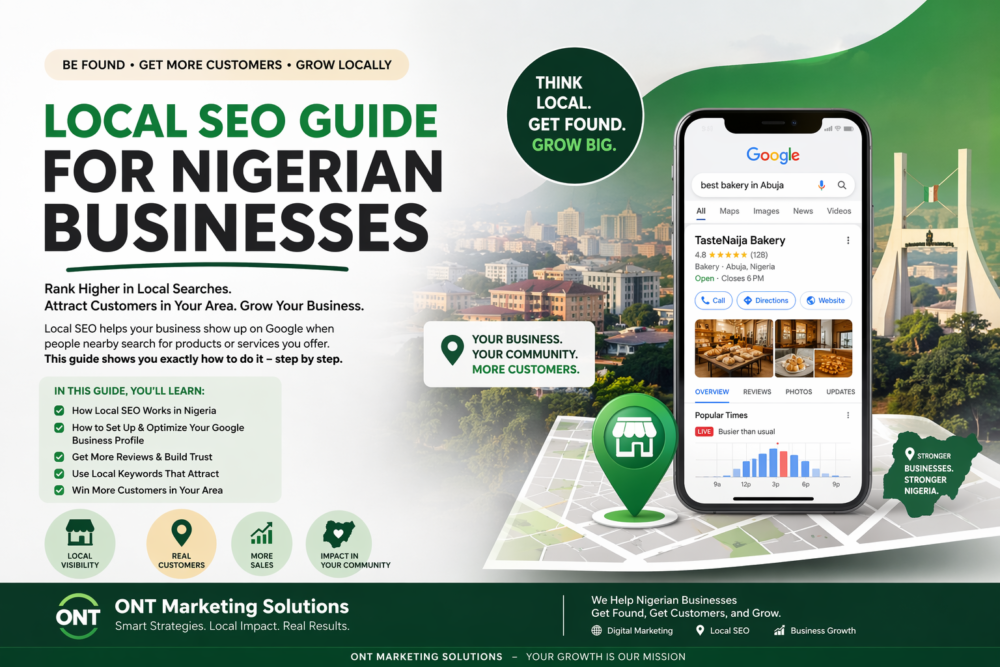
For local service businesses in Nigeria marketing agencies, law firms, restaurants, contractors, clinics, the Google Business Profile (GBP) is often more important than the website itself. The local pack (the three-business box on Google Maps) appears above all organic results for location-based searches and captures the majority of clicks from buying-intent searchers.
A Nigerian business not ranking on Google for local queries frequently has one of these GBP problems: the profile does not exist, it exists but is unverified, or it exists and is verified but is 30% complete with no photos, no services listed, no Q&A, and no reviews.
The fix:
- Claim and verify your Google Business Profile at business.google.com
- Complete every field — business name, address, phone, website, hours, categories, services, description
- Add a minimum of 10 photos including: exterior, interior, team, work samples, and logo
- Build a review generation system — ask every client to leave a Google review. Aim for 3-5 new reviews per month
- Seed the Q&A section with 5-8 self-answered questions using your target keywords naturally
- Post weekly updates using the GBP Posts feature — these are a local ranking signal
Reason 7: NAP Inconsistency Across the Web
NAP stands for Name, Address, Phone — the three pieces of business information Google cross-references across the web to verify that a business entity is real and trustworthy.
If your website says ‘ONT Marketing Solutions’ but your Facebook page says ‘ONT Marketing,’ and your VConnect listing shows a phone number you stopped using two years ago, Google’s confidence in your business identity drops and so do your local rankings.
This is one of the most invisible reasons a Nigerian business is not ranking on Google, because the inconsistencies are scattered across platforms most business owners never think to check.
The fix:
- Audit your business information on every platform: website, GBP, Facebook, Instagram, LinkedIn, all business directories
- Standardise the exact format of your business name, address, and phone number — character for character
- Update or delete any outdated listings. A listing with the wrong phone number is worse than no listing at all
Reason 8: No Schema Markup
Schema markup is structured data — code that tells Google explicitly what your content is: a local business, a service, a FAQ, a review. Without schema, Google must infer this information from context. With schema, you eliminate all ambiguity and become eligible for rich results: star ratings in search snippets, FAQ drop-downs, review boxes, and knowledge panel information.
Virtually no Nigerian business websites have schema markup of any kind. This means they are competing at a structural disadvantage against any international competitor who has implemented it.
The fix:
- Implement LocalBusiness schema with your name, address, phone, hours, geo coordinates, and social profile URLs
- Add FAQPage schema to any page with FAQ questions — this can double your SERP real estate
- Add Service schema to each service page
- Add AggregateRating schema if you have reviews to display
- Test all schema at search.google.com/test/rich-results
Reason 9: Zero E-E-A-T Signals
Google’s E-E-A-T framework (Experience, Expertise, Authoritativeness, Trustworthiness) is the quality assessment standard applied by human quality raters and reflected in algorithm updates. A Nigerian business website with no About page, no named staff, a Gmail address as the primary contact, and content that could have been written by anyone fails every E-E-A-T test.
The March 2026 Core Update specifically targeted websites with weak E-E-A-T signals, causing significant ranking drops for sites that had been performing reasonably well without genuine authority signals.
The fix:
- Create an About page with real names, photos, credentials, and the founding story of the business
- Attribute all blog posts and articles to a named author with a bio page
- Switch from Gmail to a branded professional email (info@yourdomain.com)
- Add a Privacy Policy and Terms of Service page
- Display client logos, testimonials, and case studies with real results
Reason 10: Targeting Highly Competitive Keywords Without Domain Authority
A new Nigerian business website with a Domain Authority of 5 targeting the keyword ‘digital marketing Nigeria’ is competing against sites with DAs of 40-60 that have been building authority for years. This is not an SEO problem as it is a strategy problem.
Competing for head terms you cannot realistically win is one of the most demoralizing SEO mistakes Nigerian businesses make. They invest in content, see no results at position 57, and conclude SEO does not work. The content may be excellent — it is just aimed at the wrong target for the current stage of the site’s development.
The fix:
- Use Ahrefs or Semrush to check the DA (Domain Authority) or DR (Domain Rating) of pages ranking for your target keywords
- If pages ranking on page 1 have DR 40+, start with long-tail variations of those keywords where the competition is DR 15-25
- Build up from low-competition long-tail terms and add more competitive terms progressively as your domain authority grows
Reason 11: No Internal Linking Strategy
Internal links such as links from one page on your site to another serve two critical functions: they tell Google which pages are most important (link equity flows to pages with more internal links), and they help Google understand how pages relate to each other topically (building subject authority).
Most Nigerian business websites have navigation links and nothing else. No contextual links within body content. No ‘related services’ links. No links from blog posts to service pages. This means Google cannot determine which pages deserve the most authority, and topical relevance signals are scattered rather than concentrated.
The fix:
- Every blog post should contain at least 2 internal links to relevant service pages using descriptive anchor text
- Service pages should link to related services
- The homepage should link to all primary service pages and key location pages
- Use keyword-rich anchor text — not ‘click here’ but ‘read our guide to local SEO for Nigerian businesses‘
Reason 12: No Consistent Content Strategy
A website that publishes one blog post in January and nothing else until October is signaling inactivity to Google. While Google has stated that publishing frequency alone is not a direct ranking factor, the compounding effects of consistent publishing are measurable: more indexed pages, more keyword coverage, more internal linking opportunities, more backlink targets, and stronger topical authority.
The businesses dominating Google in Nigeria’s digital marketing, fintech, and professional services sectors are those publishing consistently and not every day, but with a predictable, quality-first cadence. 1-2 well-researched posts per week compounds dramatically over 12 months.
The fix:
- Build a content calendar targeting 1-2 posts per week minimum
- Each post should target a specific keyword with real search volume
- Prioritise informational and educational content that answers real questions Nigerian business owners are asking
- Update existing content every 6-12 months to maintain freshness signals
Why Your Nigerian Business Is Not Ranking: A Diagnostic Checklist
| QUICK AUDIT: If you can tick YES on fewer than 6 of these 12 items, the reasons your Nigerian business is not ranking on Google are right in front of you. Every NO is a confirmed ranking suppressor. |
- Website indexed in Google Search Console ✓ or ✗
- Mobile page speed: LCP under 2.5 seconds ✓ or ✗
- Target keywords based on actual search data, not guesswork ✓ or ✗
- Every service page has 800+ words of quality content ✓ or ✗
- Backlinks from at least 5 credible Nigerian sources ✓ or ✗
- Google Business Profile verified and 90%+ complete ✓ or ✗
- NAP consistent across all platforms ✓ or ✗
- LocalBusiness and FAQPage schema implemented ✓ or ✗
- About page with named team, credentials, and real history ✓ or ✗
- Not targeting head terms that are years beyond current domain authority ✓ or ✗
- Internal linking strategy with contextual links throughout site ✓ or ✗
- Publishing at least 1 quality blog post per week ✓ or ✗
Conclusion
Every Nigerian business that is not ranking on Google has a reason and in almost every case I have audited, the reasons are not mysterious. They are the 12 issues above, usually in combination, creating a cumulative invisibility that makes the business uncompetitive in organic search regardless of how good the actual service is.
The competitive landscape in Nigeria’s online search space is wide open. The businesses taking SEO seriously today are establishing first-page positions that will compound in value for years.
For the Nigerian business not ranking on Google right now, the good news is that every single one of these problems is fixable. The question is whether you will fix them before your competitor does.
| NEXT STEP: Book a free SEO audit with ONT Marketing Solutions. We will run a comprehensive technical and content audit of your website and give you a prioritised action list of exactly what is preventing your rankings — at no cost. |