Nigeria has crossed a milestone that most business owners have not fully grasped yet. As of November 2025, internet penetration in Nigeria hit 50.58% according to the Nigerian Communications Commission meaning over 120 million Nigerians are now online, with more than 84% of that traffic generated on mobile devices. Understanding how SEO works in Nigeria is no longer optional for a business that wants to grow.
It is the difference between being found and being invisible. This is not a theoretical overview. It is a practitioner’s breakdown of exactly how SEO works in Nigeria, what makes the Nigerian search environment unique, and what your business needs to do to appear at the top of Google when your customers are looking for you.
What Is SEO and Why Does It Work Differently in Nigeria?
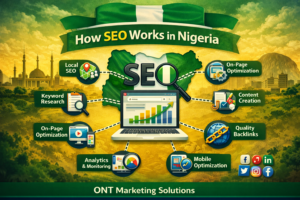
Search Engine Optimisation (SEO) is the process of making your website rank higher on Google and other search engines without paying for ads. When someone in Lagos types ‘digital marketing agency Nigeria’ or a buyer in Abuja searches ‘reliable electronics importer,’ Google decides in milliseconds which websites to show first. SEO is the work that determines whether your website is one of them.
Understanding how SEO works in Nigeria requires acknowledging that the Nigerian search environment has specific characteristics that differ significantly from Western markets:
| 84% | of Nigerian internet traffic is generated on mobile devices — making mobile-first SEO non-negotiable (Statista, 2025) |
| 107M+ | active internet users in Nigeria as of January 2025, growing at 1.9% annually (DataReportal, Digital 2025: Nigeria) |
| 50.58% | internet penetration as of November 2025 — crossed 50% for the first time, signalling enormous growth opportunity (NCC, December 2025) |
| Low comp | Most Nigerian competitors publish thin, short content — well-optimised 2,000+ word pages dominate in almost every niche |
The Three Pillars of How SEO Works in Nigeria
Google’s ranking algorithm evaluates over 200 signals, but they all flow from three foundational pillars. Every aspect of SEO technical, on-page, and off-page ultimately serves one of these:
1. Crawling and Indexing
Before Google can rank your page, it needs to find it and understand it. Googlebot and Google’s web crawler visits websites by following links, reads the content, and stores it in Google’s index.
If your site has no sitemap, blocks crawlers in the wrong places, or uses JavaScript that Googlebot cannot read, your pages may never enter the index at all. No index means no ranking, no matter how good your content is.
For Nigerian websites specifically, this is a critical vulnerability. Many locally-built sites use page builders that generate bloated JavaScript, slow load times on Nigeria’s 3G/4G infrastructure, and poorly structured HTML that confuses Googlebot. The first job of SEO in Nigeria is making sure Google can actually find and read your pages.
2. Relevance — Matching What Searchers Want
Once Google finds your page, it evaluates whether your content matches what the searcher actually wants. This is called searcher intent, and it is the most important concept in understanding how SEO works in Nigeria.
Google categorizes every search as one of four intent types: informational (learning something), navigational (finding a specific site), commercial (comparing options), or transactional (ready to buy or hire).
Nigerian searchers are highly intentional. Queries like ‘SEO agency Lagos’ or ‘how to rank on Google Maps in Nigeria’ carry commercial intent as the searcher wants to find and hire someone. Queries like ‘what is SEO’ carry informational intent they want to learn.
Your content must precisely match the intent behind your target keyword. Publishing an informational how-to guide when the searcher wants to compare agencies will not rank, regardless of quality.
3. Authority — Why Google Should Trust You Over Competitors
Google’s third evaluation is authority: is this website a credible source? Authority is primarily built through backlinks other websites linking to yours.
When the BusinessDay Nigeria website links to your article, Google interprets it as a vote of confidence. Backlinko’s analysis of 11.8 million Google search results found that the number-one result has an average of 3.8 times more backlinks than positions 2 through 10.
In Nigeria, the authority bar is substantially lower than in Western markets. Most Nigerian business websites have fewer than 20 backlinks. A focused link-building campaign targeting Nigerian business directories, local press, and industry publications can build meaningful domain authority within 6 to 12 months and produce first-page rankings in competitive niches.
How Google Ranks Pages: The Step-by-Step Process
- A Nigerian user types a query into Google e.g., ‘web developer Lagos’
- Google retrieves all indexed pages it considers relevant to this query
- Google ranks these pages using its algorithm, evaluating relevance, authority, page experience, E-E-A-T signals, and dozens of other factors
- Google presents the top 10 results on page 1, with the most authoritative, relevant, and trustworthy pages at the top
- The user clicks 71.33% of all clicks go to the first page, according to Chitika Research. Position 1 captures 28.5% of all clicks alone (Advanced Web Ranking, 2025)
| KEY INSIGHT: Appearing on page 2 of Google in Nigeria is essentially the same as not appearing at all. Page 2 results receive less than 0.78% of all clicks. The goal is always page 1, and the only route is SEO. |
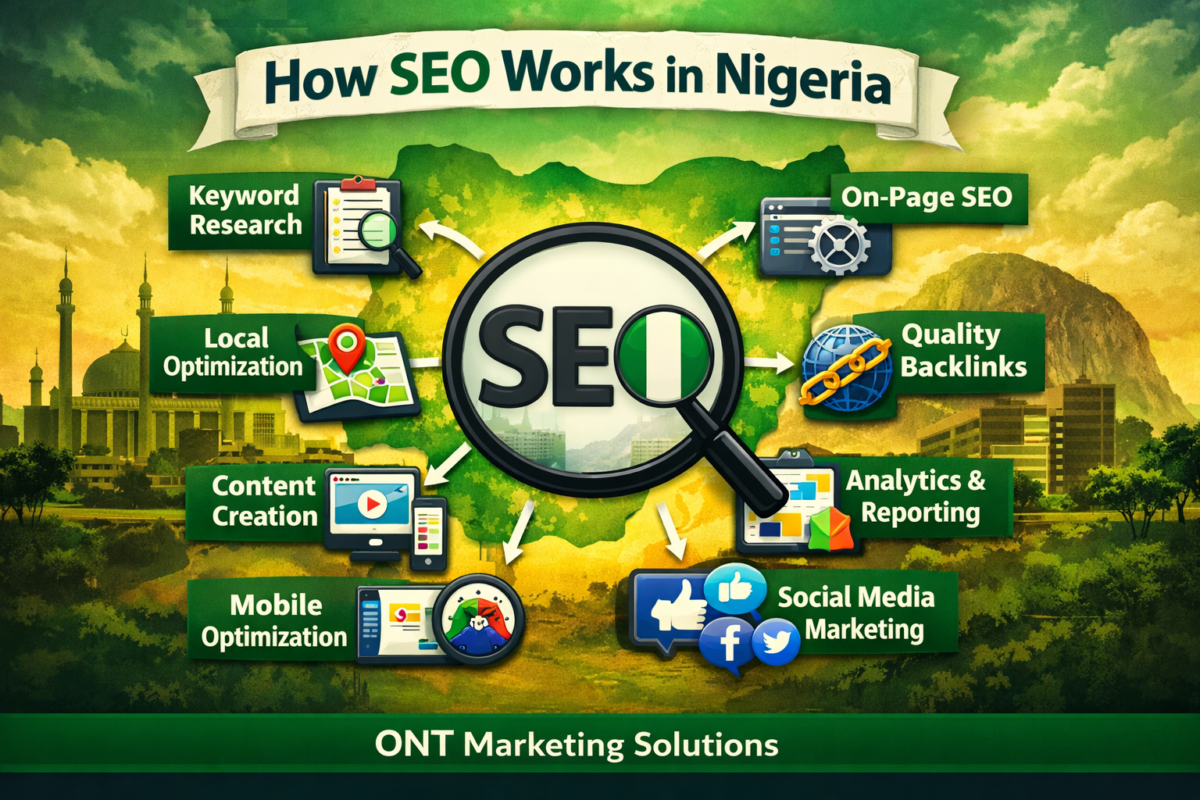
The Four Components of SEO in Nigeria
Technical SEO — The Foundation
Technical SEO ensures Google can crawl, index, and understand your website. For Nigerian websites, the most critical technical elements are:
- Page speed: Nigerian users are primarily on 3G and 4G connections with limited data. A page that takes 8 seconds to load on mobile will see users leave immediately. Google’s Core Web Vitals, Largest Contentful Paint (LCP) under 2.5 seconds, Cumulative Layout Shift (CLS) under 0.1, and Interaction to Next Paint (INP) under 200ms are direct ranking factors.
- Mobile responsiveness: With 84% of Nigerian internet traffic on mobile, a site that does not display correctly on smartphones is penalized in rankings and loses virtually every visitor it attracts.
- XML sitemap: Without a sitemap, Google may miss pages entirely. A sitemap submitted to Google Search Console is a direct instruction to Googlebot about which pages exist and how often they change.
- HTTPS: Google uses HTTPS as a ranking signal. Any Nigerian website still serving pages over HTTP is at a disadvantage and will receive browser security warnings.
- txt: This file tells Googlebot what to crawl and what to ignore. A missing or misconfigured robots.txt can accidentally block your most important pages.
On-Page SEO — Communicating Relevance
On-page SEO tells Google what each page is about and why it should rank for specific keywords. The key elements are:
- Title tags: The single most important on-page ranking signal. Must contain the primary keyword within the first 60 characters.
- Meta descriptions: Not a direct ranking factor, but controls the snippet text in search results. A well-written meta description increases click-through rate by 10-20%.
- H1, H2, H3 headings: Google reads heading structure to understand content hierarchy. Each page should have one H1 containing the primary keyword, with H2 and H3 subheadings using keyword variations.
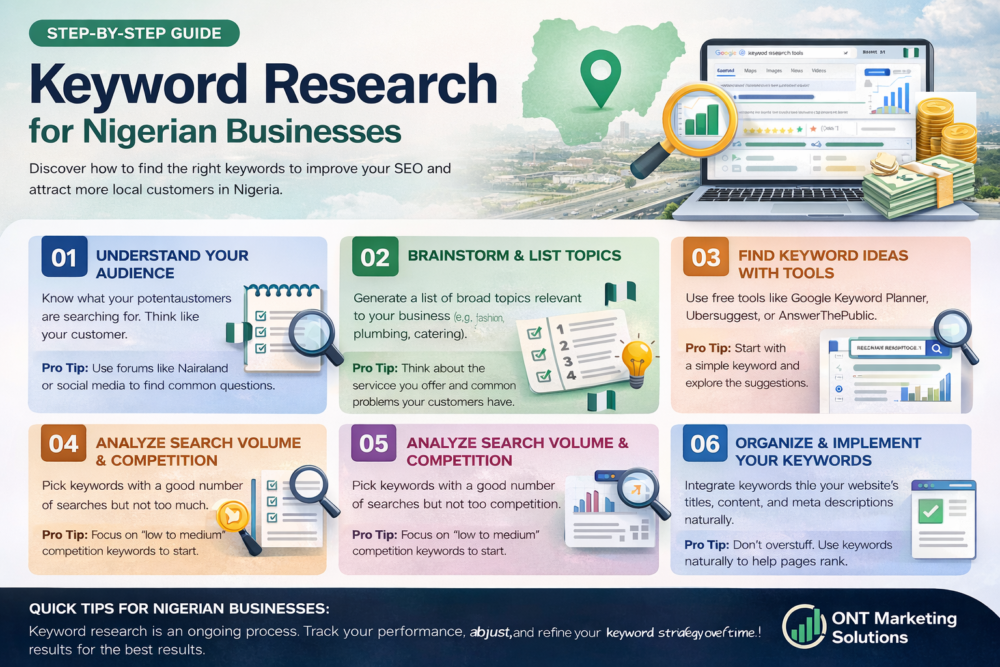
- Body content: The primary keyword should appear naturally in the first 100 words, 3-4 more times in the body, and in at least one subheading. Never force it as Google detects and penalizes keyword stuffing.
- Internal links: Links between your own pages help Google understand which pages are most important and build topical authority across your site.
- Image alt text: Google cannot see images. Alt text that describes images using relevant keywords adds additional keyword signals to the page.
Off-Page SEO — Building Authority
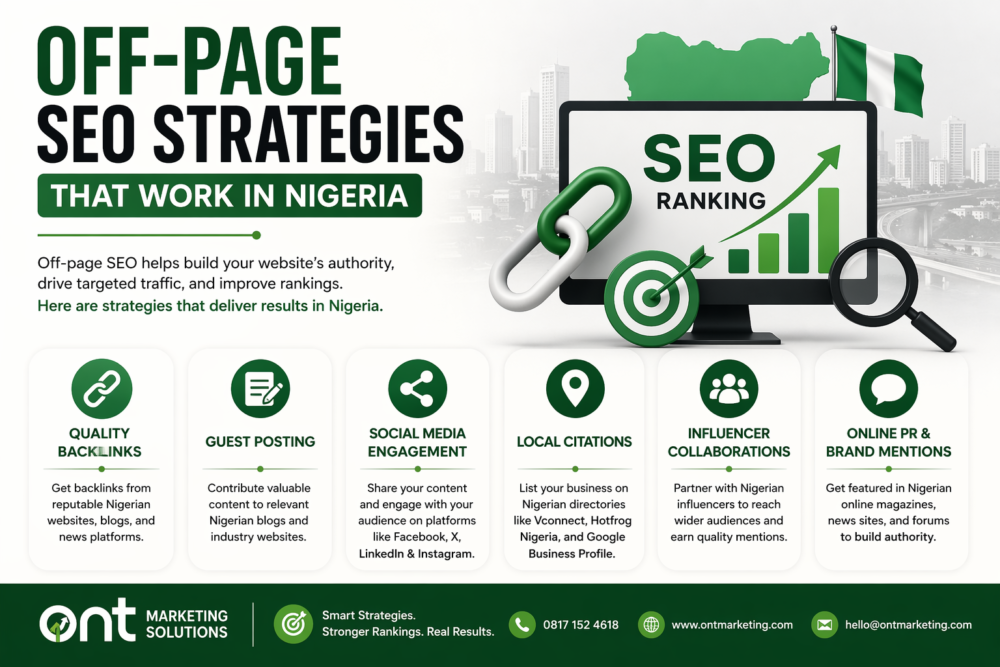
Off-page SEO is everything that happens outside your website that influences your rankings. In practice, this primarily means link building by earning links from other websites back to yours.
For Nigerian businesses, the most effective link-building sources are: Nigerian business directories (VConnect, BusinessList.ng, ConnectNigeria), local press and news sites (TechCabal, BusinessDay, Nairametrics), guest posts on Nigerian industry blogs, and the Google Business Profile itself, which counts as an authoritative citation.
Local SEO — The Map Pack Opportunity
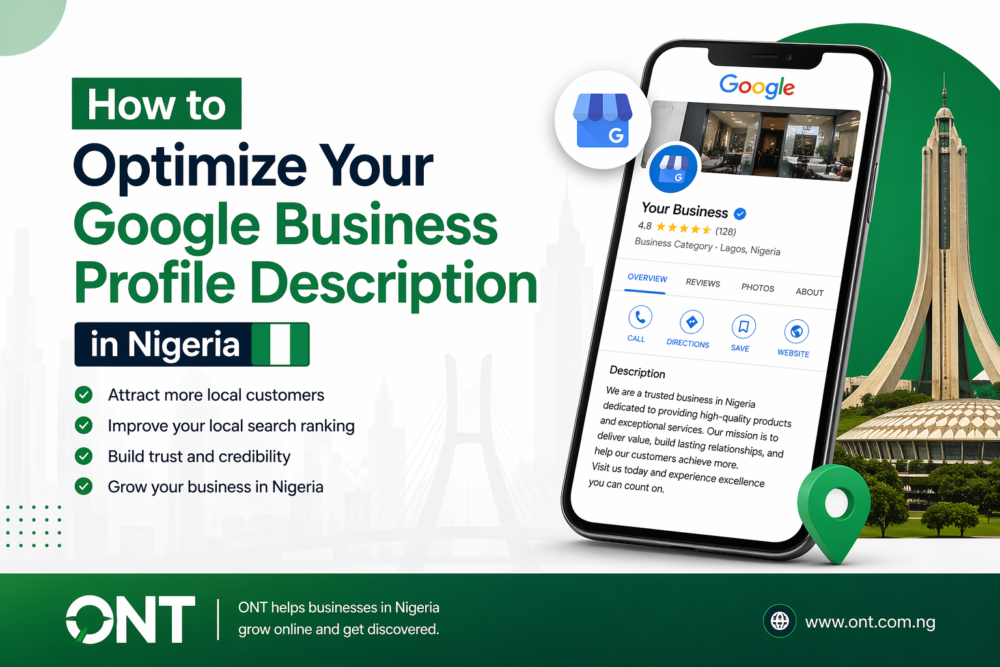
Local SEO is the process of ranking in Google Maps and the local pack as the three-business box that appears above organic results for location-based searches.
For most Nigerian service businesses, the local pack delivers more leads than organic results. According to Google, 46% of all searches have local intent, and 76% of people who search for something nearby on their phone visit a business within 24 hours.
The three factors Google uses to rank businesses in the local pack are: Relevance (how well your GBP matches the search), Distance (how close you are to the searcher), and Prominence (how well-known and trusted your business is). Only prominence can be consistently improved through SEO work via reviews, citations, backlinks, and content.
The E-E-A-T Framework: What Google Looks for in 2026
Google’s Quality Rater Guidelines introduce the concept of E-E-A-T: Experience, Expertise, Authoritativeness, and Trustworthiness. These are not direct ranking factors in the algorithmic sense, but they heavily influence how Google’s quality evaluators assess a website, and they correlate strongly with rankings for competitive queries.
- Experience: Has the content creator actually done what they are writing about? For an SEO agency writing about ranking Nigerian businesses, this means demonstrating real client results, case studies, and before-and-after data.
- Expertise: Does the site demonstrate deep subject matter knowledge? Author bios, credentials, and in-depth content that goes beyond what a generalist could write all contribute to expertise signals.
- Authoritativeness: Is the site referenced by others in the industry? Backlinks from respected Nigerian and international publications are the strongest authority signals.
- Trustworthiness: Does the site have a professional branded email, a real address, an About page with named staff, a Privacy Policy, and a phone number? Trust is about verifiability.
| NIGERIA-SPECIFIC NOTE: Nigerian websites score particularly low on E-E-A-T because most do not have named author pages, professional email addresses, or any documented proof of experience. This is actually a competitive advantage — any Nigerian business that invests in E-E-A-T signals will stand out in a market where almost no one has done this work. |
How SEO Works in Nigeria: The Timeline Reality
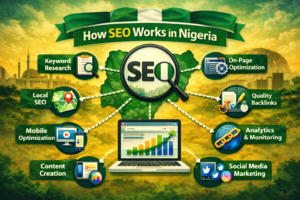
One of the most common questions from Nigerian business owners is how long SEO takes to produce results. The honest answer is: it depends on your starting point, your competition, and how aggressively you execute. But the data provides clear benchmarks:
- Months 1-3: Technical fixes, content foundation, and on-page optimisation. Little to no visible traffic increase, but impressions in Google Search Console begin to appear.
- Months 3-6: First page 2 and page 3 rankings for long-tail keywords. Traffic begins to increase meaningfully for most businesses. This is the phase most businesses quit and it is the worst possible time to stop.
- Months 6-12: Page 1 rankings for medium-competition keywords. Organic traffic compounds. Leads from organic search begin to appear consistently.
- Month 12+: Compounding authority. Pages already ranking continue to rank without additional work. New content ranks faster. Cost per lead from organic search drops significantly.
The data from FirstPageSage (2025) shows a well-executed SEO campaign delivers a median ROI of 748%, with a break-even period of approximately 9 months. Compare that to Google Ads where cost-per-lead averages $181 versus $31 for organic SEO, and the long-term financial case for understanding how SEO works in Nigeria becomes undeniable.
The 5 Most Common Reasons SEO Fails for Nigerian Businesses
- Quitting too early: Most businesses abandon SEO in months 2 to 4 when there are still no visible results. The compounding nature of SEO means this is precisely when the foundation is being laid. Businesses that persist through month 6 see a dramatically different outcome.
- Publishing thin content: A 300-word page describing a service in generic terms will not rank for competitive queries. Google rewards depth. A 2,000-word page that comprehensively covers a topic beats a 300-word page on that topic in virtually every comparison.
- Ignoring technical issues: A beautiful website that loads in 12 seconds on mobile is invisible in Google regardless of how good the content is. Technical SEO is the prerequisite, not an optional extra.
- No backlink strategy: Writing content without building links is building a house with no road to it. Nigerian businesses consistently underinvest in link building, which is precisely why the authority gap between those who do it and those who do not is so large.
- Not tracking results: Without Google Search Console and Google Analytics, you cannot see which pages are gaining impressions, which keywords are driving clicks, or where your traffic is coming from. Flying blind means you cannot double down on what is working.
How SEO Works in Nigeria: The Competitive Reality
The honest truth about how SEO works in Nigeria is that the competitive bar is remarkably low compared to global markets. An Ahrefs study found that 96.55% of all web pages get zero organic traffic from Google.
In Nigeria, the proportion is even higher most Nigerian business websites have no sitemap, no schema markup, no meta descriptions, and thin content. The opportunity is enormous for businesses that take SEO seriously.
The businesses winning organically in Nigeria in 2026 are not doing anything exotic. They are publishing comprehensive, well-researched content targeting real search queries. They have fast, mobile-friendly websites.
They have completed their Google Business Profiles. They are collecting reviews consistently. They are earning links from Nigerian business directories and local press. None of this is technically complex as it is all execution.
Conclusion
Understanding how SEO works in Nigeria is the most valuable investment a business owner or marketer can make in 2026. With 120+ million Nigerians online, internet penetration crossing 50%, and 84% of search happening on mobile, the audience is there and growing. The problem is not demand, it is visibility.
SEO works in Nigeria the same way it works globally through technical excellence, content relevance, and earned authority but with a crucial difference: the competition has barely started. Most Nigerian business websites are technically broken, content-thin, and completely unoptimised.
The businesses that understand how SEO works in Nigeria today and invest consistently over the next 12 months will establish first-page positions that compound in value for years.
The question is not whether SEO works in Nigeria. The question is whether your business will be the one that does the work.
| TAKE ACTION: If you want a free audit of why your Nigerian business website is not ranking, contact ONT Marketing Solutions at ontmarketingsolutions.com. We will identify exactly where your site stands and what it needs to compete. |