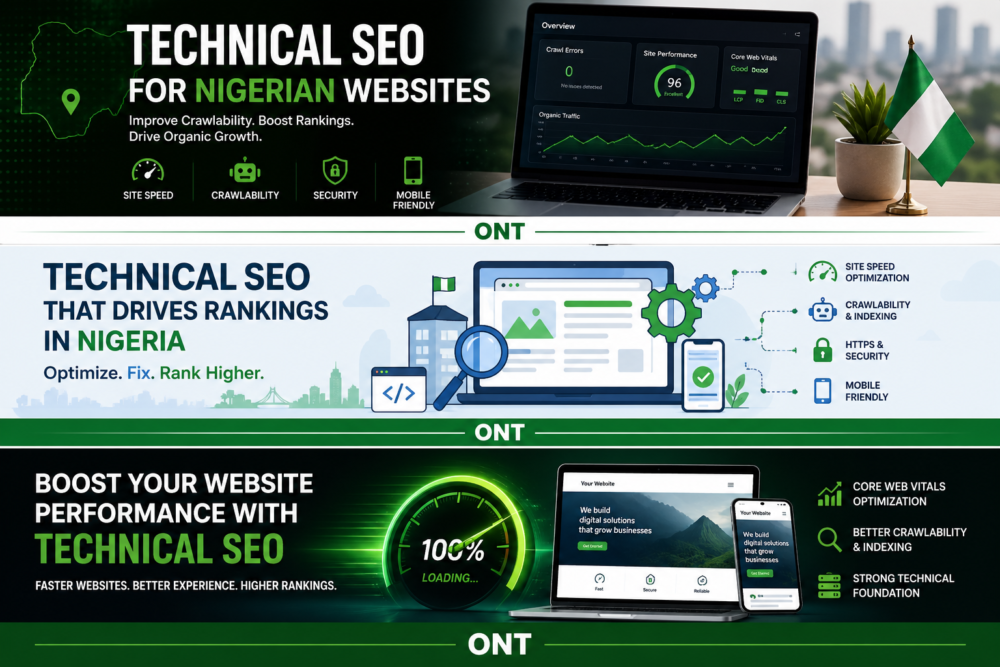
Technical SEO is the least glamorous part of digital marketing and the most consequential for ranking. You can publish the best content in Nigeria, earn links from every major business directory, and completely optimize your on-page signals and still rank poorly if Googlebot cannot crawl your pages, your mobile load time is 12 seconds, or you have duplicate content issues fragmenting your authority.
Technical SEO for Nigerian websites has a unique set of priorities driven by the market’s specific infrastructure realities: 84% of internet traffic on mobile devices, widespread use of 3G and budget 4G connections, heavy reliance on Nigerian-built CMS platforms and page builders that often produce technically poor output, and almost universal absence of the basic technical foundations like sitemaps and robots.txt files.
This guide covers every critical technical SEO element for Nigerian websites, with specific implementation steps, Nigerian market context, and tools you can use to diagnose and fix each issue.
Why Technical SEO Is the Foundation — Not an Optional Extra
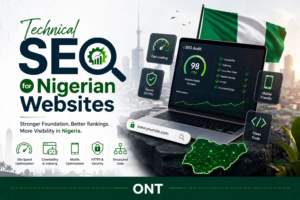
The relationship between technical SEO and other forms of SEO is sequential, not parallel. Think of it as a three-layer system:
- Technical SEO is layer 1 — it determines whether Google can crawl, index, and render your pages. If this layer is broken, nothing else matters.
- On-page SEO is layer 2 — it determines whether Google understands what your pages are about. This only works if layer 1 is functional.
- Off-page SEO (links) is layer 3 — it determines how much authority your pages have. This only functions if layers 1 and 2 are operational.
An Ahrefs study found that 90.63% of pages get no organic traffic from Google. The single most common technical cause across the sites in that study was crawlability and indexation issues — problems that prevent Google from even entering the ranking evaluation process for those pages.
| NIGERIAN CONTEXT: Technical SEO failures are disproportionately common on Nigerian websites because most were built by developers optimizing for visual appearance rather than search performance. Page builders like Elementor and Divi frequently generate bloated code, unoptimized images, excessive JavaScript, and missing technical elements that are never noticed by owners focused on how the site looks rather than how it performs. |
1. Crawlability: Making Sure Google Can Find and Read Your Pages
robots.txt Configuration
The robots.txt file is a text file at the root of your domain (yourdomain.com/robots.txt) that instructs Googlebot which pages to crawl and which to ignore. A missing robots.txt means Google has no directives at all — it will crawl everything, including admin paths, staging content, and duplicate parameter URLs that waste crawl budget. An incorrectly configured robots.txt can accidentally block your most important pages from being crawled entirely.
For Nigerian websites on WordPress (the most common CMS), the wp-admin directory, wp-includes, and all parameter-generated URLs should be disallowed. The sitemap should be declared at the bottom of the robots.txt file.
- Check: Go to yourdomain.com/robots.txt — does it exist?
- Fix: Create robots.txt with correct disallow directives for admin paths and sitemap declaration
- Test: Use Google Search Console’s robots.txt Tester to verify Googlebot can reach your key pages
XML Sitemap
An XML sitemap is a file that lists every URL on your website that you want Google to index, along with metadata about each URL: when it was last updated, how often it changes, and its relative priority. Without a sitemap, Googlebot discovers your pages by following links — and if a page has no internal links pointing to it, it may never be discovered.
For Nigerian websites, sitemap submission through Google Search Console is one of the highest-leverage technical SEO actions available: it directly informs Google of every page on your site and triggers faster indexation.
- Check: Go to yourdomain.com/sitemap.xml — does it exist?
- For WordPress: Install RankMath or Yoast SEO — both auto-generate sitemaps at /sitemap_index.xml
- For static HTML sites: Create sitemap.xml manually and upload to root directory
- Submit via Google Search Console → Sitemaps → Add new sitemap
Crawl Budget Management
Crawl budget is the number of pages Googlebot will crawl on your site within a given time period. For large Nigerian e-commerce sites or websites with many low-value pages, crawl budget management ensures Googlebot spends its time on your most important pages rather than hundreds of thin or duplicate pages.
- Use noindex on low-value pages: tags, date archives, author pages (for single-author sites), and empty category pages
- Block pagination-generated URLs in robots.txt if they produce near-duplicate content
- Remove or redirect pages with no content, no visits, and no ranking potential — they drain crawl budget
2. Core Web Vitals: The Most Critical Technical Ranking Factor in 2026
Core Web Vitals are Google’s user experience metrics — specific, measurable signals of how users experience a webpage. Since their introduction as ranking factors in 2021, they have become increasingly influential, and the 2025-2026 algorithm updates have further strengthened their weighting.
For technical SEO for Nigerian websites, Core Web Vitals deserve priority attention for one practical reason: Nigerian website performance is almost universally poor, and improvement produces direct ranking gains in a competitive environment where most sites fail these benchmarks.
Largest Contentful Paint (LCP) — Target: Under 2.5 Seconds
LCP measures how long it takes for the largest visible content element (usually the hero image or main heading) to load. For Nigerian websites, the hero image is usually the culprit — uncompressed images saved at 3-8MB being served to mobile users on 3G connections.
- Check: Run your site at pagespeed.web.dev. Find LCP element in the Diagnostics section
- Fix: Compress hero images to under 200KB using WebP format
- Fix: Use lazy loading for all images below the fold
- Fix: Move to a faster Nigerian or Africa-CDN hosting provider
- Fix: Preload the LCP image using <link rel=’preload’> in the HTML head
Cumulative Layout Shift (CLS) — Target: Under 0.1
CLS measures visual instability — how much the page layout shifts as it loads. Elements jumping around as fonts load, ads inject, or images render without defined dimensions all contribute to CLS. Nigerian websites built with ad-heavy page builders frequently have CLS issues that create poor user experiences and ranking penalties.
- Fix: Always define width and height attributes on img tags
- Fix: Reserve space for dynamically-loaded elements like WhatsApp chat widgets
- Fix: Use font-display: swap in CSS to prevent text shifts from late-loading custom fonts
Interaction to Next Paint (INP) — Target: Under 200ms
INP measures responsiveness — how quickly the page responds to user interactions like button clicks or form submissions. Heavy JavaScript frameworks and unoptimised third-party scripts (chat widgets, analytics, social embeds) are the main causes of poor INP scores.
- Fix: Defer non-critical JavaScript that does not need to load before user interaction
- Fix: Remove unused JavaScript libraries — many Nigerian websites load jQuery, Bootstrap, and animation libraries that are never fully utilised
- Fix: Load third-party scripts (Google Analytics, Facebook Pixel, Trustindex) asynchronously
3. Mobile-First Indexing: The Non-Negotiable for Nigerian Websites
Google switched to mobile-first indexing in 2019, meaning it uses the mobile version of your website as the primary basis for ranking evaluation. Given that 84% of Nigerian internet traffic is mobile-generated, a website that is not mobile-first optimised is failing both Google and the majority of its actual visitors simultaneously.
Beyond responsive design (which most modern Nigerian websites have), mobile-first technical SEO encompasses:
- Tap target size: Interactive elements (buttons, links, form fields) must be at least 44x44px. Small tap targets on mobile cause mis-clicks and high bounce rates — both negative UX signals.
- Viewport configuration: The meta viewport tag must be present and correctly configured: <meta name=’viewport’ content=’width=device-width, initial-scale=1′>
- No content hidden on mobile: Anything hidden on mobile via CSS is not indexed. If your mobile version hides a service description behind a ‘Read More’ toggle, that content may not be evaluated by Google.
- Font size readability: Body text must be legible without zooming on mobile. Google recommends minimum 16px font size for body text.
- Horizontal scrolling: Pages that require horizontal scrolling on mobile fail the Core Web Vitals assessment and create poor user experience. Test on real Android devices — emulators do not always catch horizontal overflow issues.
4. HTTPS and Security
HTTPS is a confirmed Google ranking signal. Any Nigerian website still serving pages over HTTP is at a disadvantage — both algorithmically and in user perception (modern browsers display ‘Not Secure’ warnings for HTTP pages, which dramatically increases bounce rate).
Most Nigerian hosting providers (Whogohost, QServers, SmartWeb) include free SSL certificates through Let’s Encrypt. There is no cost reason for a Nigerian business website to operate over HTTP in 2026.
- Check: Does your URL begin with https:// ?
- Fix: Contact your hosting provider to activate SSL. Most Nigerian hosts do this via a one-click activation in cPanel.
- Important: After enabling HTTPS, update all internal links from http:// to https:// to prevent redirect chains
- Verify: Check for mixed content warnings (some assets loading over HTTP while page is HTTPS) using Chrome DevTools → Console
5. Canonical Tags: Preventing Duplicate Content
Duplicate content — where the same or very similar content is accessible at multiple URLs — is one of the most common technical SEO problems for Nigerian websites. It happens when:
- The site is accessible at both www.yourdomain.com and yourdomain.com
- Pages are accessible with and without trailing slashes: /services/ and /services
- HTTP and HTTPS versions both load
- URL parameters create unique URLs for filtered or sorted versions of the same page
Duplicate content fragments link equity between multiple URLs instead of consolidating it on a single authoritative URL. A page that should rank with the combined authority of 10 backlinks instead appears as two pages each with 5 backlinks — and neither ranks as well as the consolidated version would.
- Fix: Add <link rel=’canonical’ href=’https://yourdomain.com/the-canonical-url/’> to every page
- Fix: Implement 301 redirects from HTTP to HTTPS and from non-www to www (or vice versa)
- Fix: Use the URL parameter handling tool in Google Search Console to declare how Google should handle parameter-based URLs
6. Schema Markup: The Most Underutilised Technical SEO Lever in Nigeria
Schema markup is structured data — JSON-LD code placed in the HTML head — that explicitly communicates the nature of your content to Google. It is the difference between Google guessing that you are a local business versus Google knowing you are a local business with a specific address, phone number, opening hours, service area, rating, and list of services.
For technical SEO for Nigerian websites, schema is one of the highest-leverage implementations available, because almost no Nigerian business websites have it. The schema types that deliver the most direct ranking and rich result impact for Nigerian businesses are:
LocalBusiness Schema
The most important schema type for any Nigerian service business. Declares the business entity with: name, address, phone, geo coordinates, opening hours, service area, price range, rating, social profiles (sameAs), and contact points. This schema is what enables Google Knowledge Panel appearance, local pack prominence, and entity recognition.
FAQPage Schema
Converts your FAQ section into expandable rich results in Google SERPs — accordion-style Q&A that appears directly beneath your search listing. This can effectively double the screen space your result occupies, significantly increasing click-through rate. For Nigerian business websites with FAQ sections (which most have), this is a same-week implementation with measurable impact.
Service Schema
Declares each of your services as a typed entity with a name, description, provider, service area, and pricing. This helps Google understand the specific commercial intent of each service page and contributes to better relevance matching for service-related queries.
WebSite Schema with SearchAction
Declares your website as an entity and includes a SearchAction that enables sitelinks search box in Google’s results for your brand name — a feature that appears when your domain is strong enough. For established Nigerian businesses with growing brand search volume, this is a high-value schema implementation.
AggregateRating and Review Schema
If your Nigerian business has client reviews (which all serious businesses should actively collect), AggregateRating schema enables star rating display in search results — a highly visible rich result that typically increases click-through rate by 15-25%.
- Implementation: All schema should be implemented as JSON-LD — Google’s preferred format — placed in the HTML <head> section
- Validation: Test all schema at search.google.com/test/rich-results after implementation
- Monitoring: Check Google Search Console → Enhancements section for any schema errors after Google crawls the updated pages
7. Page Speed Optimisation: The Nigerian Mobile Reality
Page speed optimisation for Nigerian websites must be calibrated to Nigerian network conditions, not US broadband speeds. A site that scores 95 on PageSpeed Insights when tested on a simulated US connection may score 45 on a simulated Nigerian 3G connection. Real-world performance on Nigeria’s mobile networks is the benchmark that matters.
Image Optimisation
- Convert all images to WebP format — 25-35% smaller than JPEG/PNG with equivalent visual quality
- Compress all images to under 150KB using Squoosh or ShortPixel
- Implement lazy loading: <img loading=’lazy’> — delays off-screen image loading until user scrolls near them
- Specify exact width and height on all img tags to prevent CLS
JavaScript and CSS Optimisation
- Remove unused CSS and JavaScript — use Chrome DevTools Coverage tab to identify unused code
- Minify all CSS and JS files — removes whitespace and comments, reducing file size by 20-40%
- Defer non-critical JavaScript using the defer attribute — prevents render-blocking
- Move JavaScript loading to end of body where possible
Hosting and Infrastructure
- Upgrade to a hosting plan with server-side caching — Hostinger Business, Whogohost Business, or SiteGround support this
- Consider a CDN (Content Delivery Network) — CDN nodes closer to Nigerian users serve assets faster
- Enable GZIP or Brotli compression at server level — reduces file transfer sizes by 60-80%
- Use browser caching with appropriate cache-control headers to speed up repeat visits
8. Structured URL Architecture
URL architecture — the logical organisation of pages into a hierarchy — affects both crawlability and topical relevance signals. A well-structured Nigerian business website has a clear URL architecture that communicates the relationship between pages:
- com/ — homepage
- com/services/ — services hub
- com/services/seo-nigeria/ — SEO service page
- com/services/local-seo-lagos/ — local SEO service page
- com/blog/ — blog hub
- com/blog/how-seo-works-nigeria/ — individual blog post
This hierarchy tells Google that the SEO service page is a subcategory of services, which is a subcategory of the main domain. It creates logical breadcrumb navigation, supports topical clustering, and makes internal linking architecturally sensible.
9. Google Search Console: The Technical SEO Diagnostic Centre
Google Search Console is the direct communication channel between Google and your website. For technical SEO for Nigerian websites, it is non-negotiable. Every significant technical issue — crawl errors, manual penalties, indexation problems, Core Web Vitals failures, schema errors — is reported in GSC. Operating a Nigerian business website without GSC connected is operating blind.
- Setup: Go to search.google.com/search-console, add your property, and verify ownership via HTML tag, DNS record, or Google Analytics
- Key reports to monitor monthly: Coverage (indexation status), Core Web Vitals, Sitemaps, Security & Manual Actions, Links, and Performance
- Submit sitemaps immediately after verification
- Use URL Inspection to request re-indexing after significant page updates
- Monitor Core Web Vitals report — GSC shows real-world CrUX data from Nigerian Chrome users, not simulated speeds
The Technical SEO Audit Checklist for Nigerian Websites
Use this as a master reference when auditing technical SEO for Nigerian websites. Every NO is a confirmed ranking suppressor:
- txt exists, is correctly configured, and declares sitemap location
- XML sitemap exists, is submitted to Google Search Console, and all important pages are included
- HTTPS active with no mixed content warnings
- www and non-www redirect to single canonical version
- LCP under 2.5 seconds on mobile (PageSpeed Insights)
- CLS under 0.1 (PageSpeed Insights)
- INP under 200ms (PageSpeed Insights)
- All images compressed, in WebP format, with lazy loading
- Mobile responsive design passing Google’s Mobile Friendly Test
- Canonical tags on every page
- LocalBusiness schema implemented and validated
- FAQPage schema on all FAQ sections
- No duplicate content from parameter URLs or www/non-www variants
- Google Search Console connected and no critical errors in Coverage report
- Google Analytics (GA4) tracking all sessions, events, and conversions
- No 404 errors on linked pages — all broken internal links fixed
- All redirects are 301 (permanent), not 302 (temporary)
Conclusion
Technical SEO for Nigerian websites is the infrastructure upon which all other digital marketing activity depends. Without it, content strategies, link-building campaigns, and social media efforts are significantly diminished. With it, every additional SEO investment delivers compounding returns because the foundation is sound.
The paradox of technical SEO in Nigeria is that it is simultaneously the most impactful and least executed aspect of digital marketing. The average Nigerian business website fails 60-70% of the technical audit checklist above. This means that any Nigerian business that implements even the core technical fixes — proper robots.txt, sitemap submission, mobile speed optimisation, HTTPS, and schema markup — immediately differentiates itself from the majority of competitors.
Technical SEO for Nigerian websites is not a one-time project. It is an ongoing monitoring and maintenance discipline. Google’s algorithm updates, new ranking signals, and changing user behaviour on Nigerian networks mean that the technical SEO work that was sufficient in 2023 may need updating in 2026. Set a quarterly technical audit as a standing item in your digital marketing calendar.
| PROFESSIONAL TECHNICAL AUDIT: ONT Marketing Solutions offers comprehensive technical SEO audits for Nigerian business websites, covering all elements in this guide with specific, prioritised fix recommendations. Contact us at ontmarketingsolutions.com. |