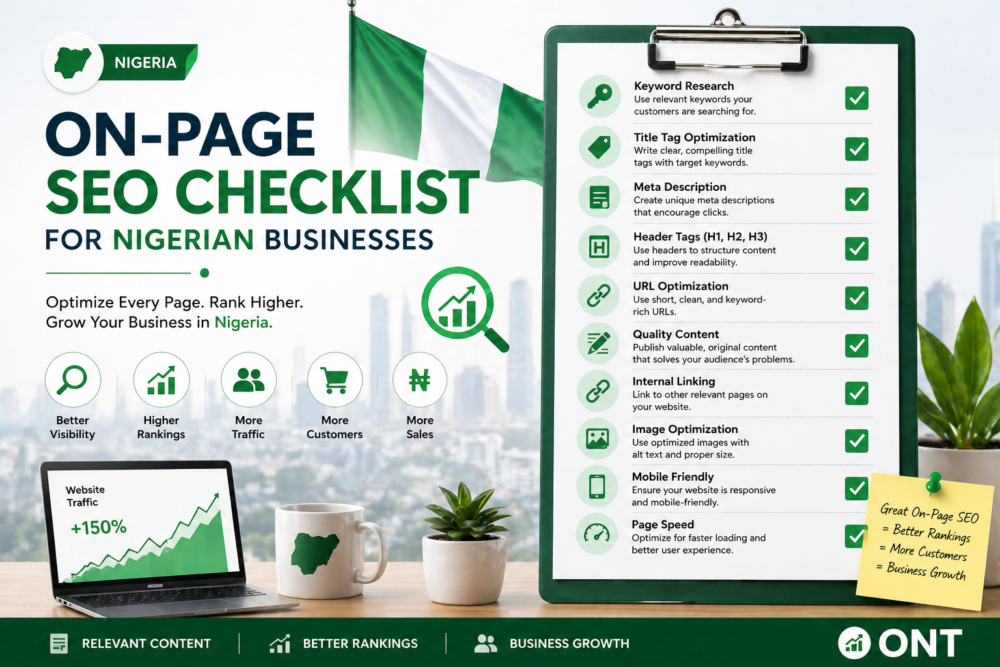
On-page SEO is the foundation on which everything else in your Nigerian business’s digital marketing is built. Without it, no amount of link building, social media activity, or Google Ads spend can compensate for pages that Google cannot properly understand, evaluate, or trust.
After auditing hundreds of Nigerian business websites, the same on-page failures appear repeatedly and they are all fixable. This on-page SEO checklist for Nigerian businesses is not a theoretical framework.
Every item on this list is something I have personally fixed on client sites and directly observed the ranking impact. Work through it systematically on your most important pages and you will have a meaningfully better-optimized website than the vast majority of your Nigerian competitors within a week.
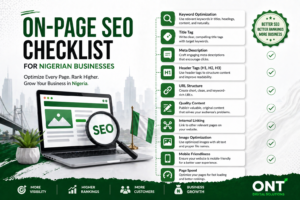
| HOW TO USE THIS CHECKLIST: Apply this on-page SEO checklist to each important page on your website individually. Start with your homepage, then your highest-value service pages, then your location pages. Each page has its own on-page SEO signals that must be individually optimized. |
Section 1: Title Tags (5 Checklist Items)
✓ 1. Title Tag Contains the Primary Keyword
The title tag is the single most important on-page ranking signal. Google reads it as the primary declaration of what the page is about. Your primary keyword must appear in the title tag — and ideally near the beginning, not buried at the end.
Bad: ‘Welcome to ONT Marketing Solutions | Digital Agency’
Good: ‘SEO Agency Nigeria | ONT Marketing Solutions’
Best: ‘SEO Agency in Lagos, Nigeria | ONT Marketing Solutions’
✓ 2. Title Tag Is Under 60 Characters
Google truncates title tags that exceed approximately 580 pixels in width (roughly 60 characters). A truncated title loses its impact in search results and may cut off your keyword. Use a title tag checker tool to confirm your titles display completely.
✓ 3. Title Tag Includes a Location Signal for Local Pages
For any page targeting a specific Nigerian city or region, the location must appear in the title tag. ‘Digital Marketing Agency Lagos’ will outrank ‘Digital Marketing Agency’ for searchers in Lagos, because the title tag explicitly matches the geographic intent of the query.
✓ 4. Each Page Has a Unique Title Tag
Duplicate title tags across multiple pages signal to Google that the pages have the same content or purpose — neither of which is helpful. Every page on your Nigerian business website must have a distinct title tag that accurately reflects that specific page’s unique content.
✓ 5. Title Tag Includes a Power Word or CTR Trigger
Beyond keyword placement, a well-crafted title tag increases click-through rate — which is itself a ranking signal. Words like ‘Complete Guide,’ ‘How To,’ ‘In Nigeria,’ ‘2026,’ ‘Free Consultation,’ and ‘Proven’ consistently increase organic click-through rates.
Section 2: Meta Descriptions (3 Checklist Items)
✓ 6. Every Page Has a Meta Description
The meta description is the 155-160 character summary that appears beneath your title in Google search results. It is not a direct ranking factor, but it is a direct CTR factor — a well-written meta description can increase organic click-through rate by 10-20%. Most Nigerian business websites have no meta descriptions, leaving Google to auto-generate snippets from random page content.
✓ 7. Meta Description Contains the Primary Keyword
Google bolds the keyword in the meta description when it matches the search query. This visual emphasis draws the searcher’s eye and communicates relevance. Include the primary keyword naturally within the first 30-40 characters of the description.
✓ 8. Meta Description Contains a Call to Action
Treat your meta description as ad copy. It should describe what the page offers and include a soft CTA: ‘Book a free consultation today,’ ‘See our client results,’ ‘Download our free guide.’ This directly increases the proportion of searchers who click your result.
Section 3: Heading Structure (4 Checklist Items)
✓ 9. One H1 Per Page Containing the Primary Keyword
The H1 is the main heading of the page and carries significant on-page SEO weight. Each page should have exactly one H1 — not zero (common on many Nigerian sites built with custom themes), not multiple — and it must contain the primary keyword. The H1 does not need to be identical to the title tag, but should closely mirror it.
✓ 10. H2 Subheadings Use Secondary Keywords and LSI Terms
H2 subheadings organize the page structure and give Google additional keyword signals. LSI (Latent Semantic Indexing) terms are words related to your primary keyword that Google expects to see on a page about that topic.
A page about ‘Local SEO Nigeria’ should have H2s containing terms like ‘Google Business Profile,’ ‘Google Maps ranking,’ ‘local citations,’ and ‘NAP consistency’ — all terms semantically related to the primary keyword.
✓ 11. No Heading Tags Used Purely for Visual Styling
A common mistake on Nigerian websites built with Elementor or other page builders is using H2 or H3 tags for visual emphasis rather than content hierarchy. If a piece of text appears in a large font as a header but does not represent a content section, it should be styled with CSS rather than HTML heading tags. Misused heading tags confuse Google’s content hierarchy interpretation.
✓ 12. Headings Follow Logical Hierarchy
Heading tags should nest logically: H1 → H2 → H3. Jumping from H1 directly to H3, or using H2 before H1, breaks the semantic structure of the page. Google’s quality evaluation systems expect and reward logical, well-structured content hierarchy.
Section 4: Content Quality (5 Checklist Items)
✓ 13. Primary Keyword in First 100 Words
Google weights the density and position of keywords throughout a page, with early occurrences carrying more signal weight. Your primary keyword should appear naturally within the first paragraph — ideally in the first 100 words. This confirms for Google immediately that the page is what the title tag says it is.
✓ 14. Primary Keyword Appears 3-5 Times Naturally Throughout the Body
The primary keyword should appear approximately 3-5 times across a 1,500-2,000 word page — enough to establish clear topical relevance without triggering keyword stuffing flags. If you feel yourself forcing the keyword into sentences where it sounds unnatural, you are overdoing it. Google’s natural language processing is sophisticated enough to detect forced keyword insertion.
✓ 15. Content Comprehensively Answers the Searcher’s Intent
Every piece of content on your Nigerian business website must be built around one central question: what does a person who types this query actually want to know or accomplish?
A page about ‘local SEO for Lagos businesses’ should cover what local SEO is, why it matters for Lagos businesses specifically, how Google ranks local results, what a Lagos business can do to improve its ranking, and what results to expect. Not just ‘we offer local SEO in Lagos’ with a contact form.
If your content can be fully read in under 2 minutes and leaves obvious questions unanswered, it will not rank competitively for informational queries. The pages dominating Google in Nigeria for most service keywords are 1,500-2,500 words minimum.
✓ 16. Content Includes Nigeria-Specific Examples and Data
Generic global content ranks poorly for Nigerian-specific queries because it does not demonstrate local expertise or contextual relevance. Any page targeting a Nigerian audience should include specific Nigerian references: Naira pricing context, city-specific examples, Nigerian business regulations where relevant, references to Nigerian platforms (Flutterwave, Paystack, Jumia), and acknowledgement of the Nigerian market’s specific characteristics.
This is not just an E-E-A-T requirement — it is the primary differentiator between content that ranks in Nigeria and content that ranks globally but is not optimised for Nigerian searcher intent.
✓ 17. Content Is Free of Factual Errors, Typos, and Grammar Issues
Google’s quality rater guidelines explicitly note that errors in content signal low E-E-A-T. A Nigerian business website with visible grammar errors, misspellings, or factual inconsistencies reduces both Google’s quality assessment and the user’s trust.
Every page should be proofread before publishing. This is particularly important for Nigerian websites where code-switched English is sometimes used in a way that reads as errors to Google’s quality systems.
Section 5: URL Structure (2 Checklist Items)
✓ 18. URL Slugs Are Short, Keyword-Rich, and Hyphenated
Page URLs should be descriptive, contain the primary keyword, and use hyphens (not underscores) to separate words. ‘yourdomain.com/services/seo-agency-nigeria/’ is correct. ‘yourdomain.com/page_id=47’ is incorrect. Short, descriptive URLs are easier for users to remember, easier for other sites to link to, and give Google an additional keyword signal.
✓ 19. No URL Parameters or Session IDs in Indexed Pages
Dynamic URLs containing parameters like ‘?session_id=1234’ or ‘?ref=homepage’ should not be indexed. These create duplicate content issues where Google sees multiple URL versions of the same page. Use canonical tags or robots.txt to ensure only clean, canonical URLs are indexed.
Section 6: Images (2 Checklist Items)
✓ 20. All Images Have Descriptive, Keyword-Rich Alt Text
Google cannot see images — it reads the alt text attribute to understand what an image shows. An image of your team in Lagos should have alt text like ‘ONT Marketing Solutions team in Lagos Nigeria’ not ‘image_001.jpg’ or a blank attribute. Alt text is a legitimate on-page keyword signal and an accessibility requirement.
✓ 21. All Images Are Compressed and Sized Appropriately
Uncompressed images are the single most common cause of slow page load times on Nigerian websites. A hero image saved at 5MB is unacceptable for a Nigerian mobile user on a limited 4G connection. Use tools like Squoosh, ShortPixel, or TinyPNG to compress images to under 200KB without visible quality loss. For a WordPress blog, activate WebP conversion and lazy loading.
Section 7: Internal Linking and Schema (4 Checklist Items)
✓ 22. Each Page Has At Least 2 Internal Links With Descriptive Anchor Text
Internal links redistribute authority across your site and help Google understand content relationships. Every page should link contextually to at least 2 other relevant pages using anchor text that includes keywords. Not ‘click here’ — but ‘read our complete guide to Local SEO for Nigerian businesses.’
✓ 23. Service Pages Are Linked From the Homepage and Blog Posts
Your service pages are your most commercially important pages — they need the most internal link equity flowing to them. Every relevant blog post should link to the appropriate service page. The homepage should link directly to all primary service pages. This concentrates authority on the pages that need to rank for commercial queries.
✓ 24. Canonical Tag Declared on Every Page
Canonical tags tell Google which URL is the authoritative version of a page, preventing duplicate content issues. If your website is accessible at both https://www.yourdomain.com/ and https://yourdomain.com/ (with and without www), and both are indexable, Google sees two versions of every page. A canonical tag points both versions to the single authoritative URL.
✓ 25. Schema Markup Implemented for Business Type, Services, FAQs, and Reviews
Schema markup is structured data that explicitly tells Google what your content represents — a local business, a service, a FAQ, a review. Without schema, Google infers this from context. With schema, you eliminate ambiguity and become eligible for rich results: star ratings in search results, FAQ expansions, knowledge panel information.
For most Nigerian businesses, the minimum schema implementation should include: LocalBusiness (with address, phone, hours, geo coordinates), Service (for each service page), FAQPage (for any page with FAQ content), and AggregateRating (if you have reviews). This alone puts you in a different tier from 95% of Nigerian competitor websites.
The On-Page SEO Checklist for Nigerian Businesses: Priority Order
If you cannot implement all 25 items simultaneously, prioritise in this order based on ranking impact:
- Title tags and meta descriptions (all pages) — highest impact, fastest to implement
- H1 correction with primary keyword — typically takes 30 minutes per page
- Content depth expansion — most time-intensive but highest sustainable impact
- Schema markup (LocalBusiness + FAQPage minimum) — moderate effort, significant rich result eligibility
- Image compression and alt text — addresses speed and crawlability simultaneously
- Internal linking audit — usually 2-4 hours for a complete site review
- URL structure cleanup — requires planning to avoid broken links
- Canonical tags — quick technical implementation with significant duplicate content protection
Conclusion
The on-page SEO checklist for Nigerian businesses presented here is not aspirational — it is the minimum competitive standard for any Nigerian website that wants to rank for its target keywords in 2026. Google’s algorithm has become sophisticated enough to differentiate between pages optimised by practitioners who understand these signals and pages optimised by people following a basic checklist.
The businesses whose Nigerian websites already tick all 25 of these boxes are outranking those that tick 5-10. The gap between a fully optimized Nigerian business website and the average competitor website in most niches outside Lagos and Abuja is enormous — and it is a gap that can be closed in weeks rather than months with systematic implementation of this checklist.
Start with your homepage and your highest-revenue service page. Apply every applicable item on this on-page SEO checklist. Then move to the next page. Within a month of consistent implementation, you will have a meaningfully better-optimised website than the vast majority of your Nigerian competitors.
| GET A PROFESSIONAL AUDIT: ONT Marketing Solutions can audit your entire website against this checklist and implement all fixes for you. Contact us for a free on-page audit at ontmarketingsolutions.com. |