There is a concept in local SEO that kills rankings so quietly most Nigerian business owners never identify it as the cause. Their Google Business Profile looks correct. Their website looks fine.
They have some reviews. But Google Maps rankings stubbornly refuse to move. The silent culprit, in case after case, is NAP inconsistency and it is everywhere on Nigerian business websites and directory listings.
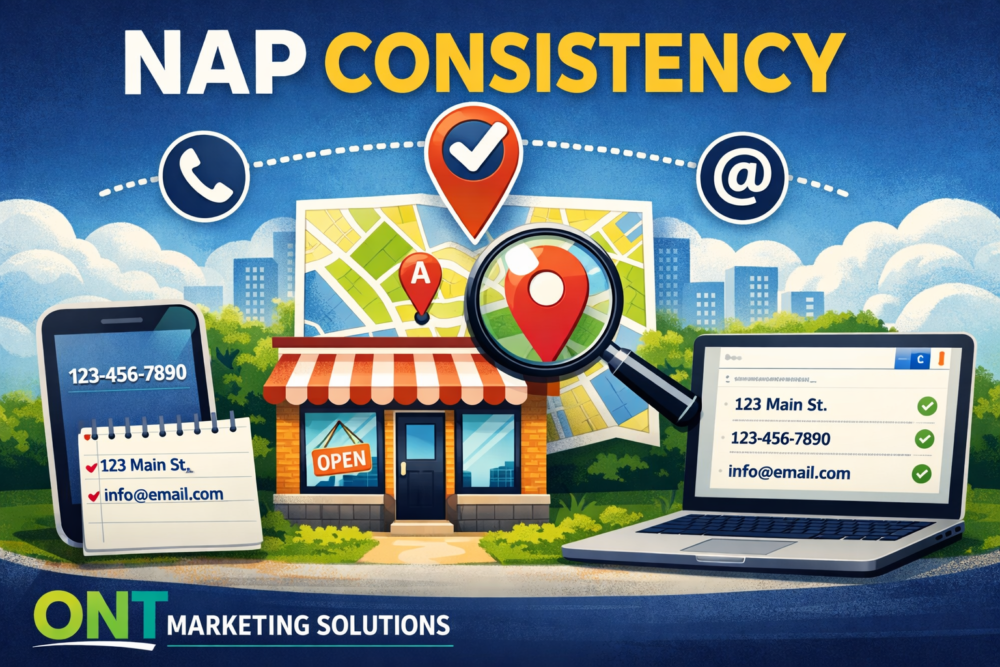
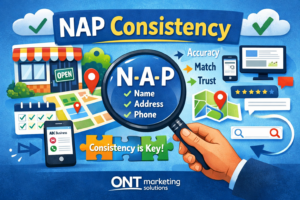
NAP consistency in Nigeria SEO refers to ensuring your business Name, Address, and Phone number are identical character for character across every platform where your business appears online.
Google cross-references your business information across dozens of sources to build confidence in your entity’s legitimacy. When the data conflicts, that confidence drops. Dropped confidence equals dropped rankings.
23% more likely to appear in the Google Maps 3-Pack for businesses maintaining consistent NAP across at least 15 platforms (2024 study via Seowerkz)
68% of consumers would stop using a local business if they found incorrect information online (Seowerkz research, 2024)
186% increase in website clicks from Google for businesses with consistent information across 75%+ of major directories (industry data, 2025)
Why NAP Consistency Matters More Than Ever in 2026
In 2026, NAP consistency in Nigeria SEO is not just a local ranking signal as it is a foundational requirement for visibility in AI-powered search. When ChatGPT, Google Gemini, and Perplexity answer questions like ‘best digital marketing agency in Lagos,’ these AI systems pull data from multiple sources and cross-reference for consistency.
The SOCi Local Visibility Index 2026 found that only 68% of business contact information on ChatGPT and Perplexity matches details on Google Business Profiles — meaning 32% of businesses are already invisible or inaccurate in AI search environments.
For Nigerian businesses, this is both a problem and an opportunity. The problem: if you have inconsistent NAP data scattered across the web, you are already invisible in an emerging discovery channel that 45% of consumers now use for local business recommendations (BrightLocal Local Consumer Review Survey, 2026).
The opportunity: most Nigerian competitors have even more severe NAP inconsistency issues, meaning early correction produces immediate competitive differentiation.
THE AI ANGLE: A regional law firm that completed a comprehensive NAP consistency project across 47 platforms in 2025 saw AI-generated local search visibility increase by 340% and voice search traffic grow by 520% within four months. The investment in NAP consistency directly produced a 28% increase in new client inquiries. (Jasmine Directory case study, 2025)
What Counts as a NAP Inconsistency?
Most Nigerian business owners check their GBP and website, see the same address, and conclude NAP consistency is not an issue. They are wrong for two reasons: first, most inconsistencies are scattered across directories, social profiles, and listings they created years ago and forgot about. Second, even minor formatting differences count as inconsistencies to Google’s entity-matching algorithm.
Examples of NAP inconsistencies that suppress Google Maps SEO for Nigerian businesses:
⦁ Business name: ‘ONT Marketing Solutions’ vs ‘ONT Marketing’ vs ‘ONT Marketing Solutions Ltd’ — three different entities to Google
⦁ Address: ’18 Oluwole Lawal Street, Ibafo, Ogun State’ vs ’18 Oluwole Lawal St, Ibafo’ vs ’18 Oluwole Lawal Street, Ibafo Ogun’ — all different
⦁ Phone: ‘09026401198’ vs ‘+2349026401198’ vs ‘0902 640 1198’ — Google may not link these as the same number
⦁ Abbreviations: ‘Street’ vs ‘St’, ‘Avenue’ vs ‘Ave’, ‘Limited’ vs ‘Ltd’ — each variation creates entity ambiguity
⦁ Old phone numbers that were changed 2 years ago still appearing on forgotten directory listings
⦁ Previous addresses from before a business relocation still live on platforms that were never updated
The NAP Inconsistency Sources Most Common in Nigeria
Understanding where Nigerian businesses accumulate NAP inconsistencies helps prioritise the audit:
Social Media Profiles
Facebook, Instagram, LinkedIn, and Twitter/X business profiles often have different address formats, old phone numbers, or abbreviated business names. These are high-authority sources that Google actively crawls and cross-references.
Business Directories
VConnect, BusinessList.ng, ConnectNigeria, Finelib are Nigerian businesses that created listings 3-5 years ago frequently have outdated phone numbers or addresses that were never updated after business changes. Each outdated listing is an active NAP inconsistency signal.
Google Business Profile vs Website
The most common Nigerian NAP inconsistency: the GBP shows one address format and the website shows another. Sometimes the phone number linked on the website is a WhatsApp number while the GBP shows a standard mobile number. These are treated as different entities.
Multiple Locations Without Clear Primary Designation
ONT Marketing Solutions has two offices in Ogun and Ibadan. Without clearly designating which is the primary GBP address and ensuring the website and all secondary platforms agree, Google receives conflicting geographic signals about where the business is primarily located.
Agency-Created Listings You Never Knew Existed
Past marketing agencies, SEO freelancers, or even well-meaning staff may have created business directory listings that you have no knowledge of and no access to. These orphaned listings frequently have old contact information and represent NAP inconsistency sources you cannot even find without a systematic audit.
The Step-by-Step NAP Audit for Nigerian Businesses
Step 1: Create Your Master NAP Record
Before auditing, establish the single source of truth. Create a document with the exact format you will use everywhere:
⦁ Business Name: Use the exact name as it appears on your CAC registration or primary operating name — do not abbreviate, do not add keywords
⦁ Address: Choose one format and use it everywhere. Include state and country. Decide whether to abbreviate street types or spell them out — and never deviate
⦁ Phone: Choose your primary business phone. Decide whether to use +234 format or 0XX format — pick one and use it universally
⦁ Email: Use your branded business email, not Gmail, in all listings
⦁ Website: Use the canonical URL with https:// — decide whether to include www or not and be consistent
Step 2: Audit All Existing Citations
Search Google for each of the following and document what you find in a spreadsheet:
⦁ Your business name in quotes: “ONT Marketing Solutions”
⦁ Your phone number in all formats: 09026401198, +2349026401198
⦁ Your address: “18 Oluwole Lawal Street Ibafo”
⦁ Also check: Facebook, Instagram, LinkedIn, Twitter, VConnect, BusinessList.ng, ConnectNigeria, Finelib
For each listing found, record the platform URL, current NAP as listed, and what needs to be corrected.
Step 3: Prioritise Corrections by Platform Authority
Not all citations are equally important. Prioritise corrections in this order:
1. Google Business Profile — most critical
2. Your own website — homepage, footer, contact page
3. Facebook Business Page
4. LinkedIn Company Page
5. VConnect, BusinessList.ng, ConnectNigeria
6. All other discovered listings
Step 4: Update or Claim Each Listing
For each listing with incorrect NAP: log in to claim the listing if you do not control it, or log in to edit if you do. Update every field to match your master NAP exactly. If a listing is completely outdated and cannot be claimed, contact the directory’s support to request correction or removal.
Step 5: Implement Ongoing NAP Monitoring
NAP consistency is not a one-time project — it requires quarterly monitoring because:
⦁ Google and third-party services sometimes auto-update GBP information based on data they pull from other sources — information you never submitted
⦁ New citations get created when your business is mentioned online, sometimes with incorrect data
⦁ Staff members or freelancers may create new listings without following your master NAP format
Set a quarterly calendar reminder to run the audit process in Step 2 and correct any new inconsistencies found.
NAP Consistency and Schema Markup: The Technical Connection
Schema markup is the technical layer that amplifies the impact of NAP consistency. When you implement LocalBusiness schema on your website with your master NAP data, you are giving Google a machine-readable declaration of your business entity that directly references the same data in your GBP.
This creates a triangulated entity confirmation: GBP says X, website HTML says X, schema markup confirms X and Google’s confidence in your entity reaches its maximum level.
For Nigerian businesses, schema markup is almost universally absent which means implementing it simultaneously with NAP consistency cleanup produces compounded impact.
The combination of consistent NAP across all platforms plus correctly implemented LocalBusiness schema can produce measurable local pack movement within 30-60 days.
⦁ Implement LocalBusiness schema on your homepage
⦁ Include address in schema matching GBP exactly
⦁ Include telephone matching GBP exactly
⦁ Include geo coordinates matching your GBP pin location
⦁ Include sameAs array with URLs of all your social profiles and directory listings
The NAP Consistency Impact on AI Search Visibility
As AI search becomes a primary discovery channel for Nigerian businesses, 45% of consumers now use AI tools for local business recommendations and NAP consistency takes on a new dimension. AI systems use a citation authority hierarchy when resolving conflicting business data:
⦁ Government/official registrations: CAC, tax records — treated as ground truth
⦁ Verified major platforms: Google Business Profile, Facebook, LinkedIn — second tier of authority
⦁ Industry directories and general directories — third tier
⦁ Informal web mentions — lowest tier
When these sources conflict, AI systems default to the highest-authority source. If your GBP says one thing and your Facebook page says something different, the AI gives Google data precedence — but the inconsistency itself reduces the confidence with which the AI will recommend your business.
Conclusion
NAP consistency in Nigeria SEO is not a glamorous topic. It does not get the attention of content strategy or link building. But it is the silent foundation underneath every other local SEO effort. Build content, earn links, and collect reviews on top of inconsistent NAP data and you are building on sand.
The Google Maps algorithm uses NAP signals to build entity confidence, and reduced confidence directly suppresses rankings regardless of how well other signals are optimised.
The Nigerian business that runs a systematic NAP audit, establishes a master NAP format, corrects all inconsistencies, implements LocalBusiness schema, and commits to quarterly monitoring is building a local search foundation that compounds in advantage over time.