A Nigerian website that is not ranking on Google is not necessarily broken as it is usually misconfigured, mis-optimized, or misaligned with the signals Google uses to evaluate ranking merit. The purpose of an SEO audit is to systematically find every configuration, optimization, and alignment failure and produce a prioritized action plan to fix them.
This SEO audit framework was developed from auditing Nigerian client websites across industries fintech, real estate, e-commerce, service businesses, professional services, and local businesses.
The patterns of failure are remarkably consistent: the same technical issues, the same on-page gaps, the same off-page neglect, and the same local SEO mistakes appear in Nigerian website after Nigerian website. This guide gives you the complete audit process and the specific fixes that produce measurable ranking improvements for Nigerian sites.
| BEFORE YOU START: The single most important pre-audit setup: Connect your site to Google Search Console if you have not already. GSC provides data that no third-party tool can replicate specifically, how Google actually sees your site, which queries are producing impressions, which pages are indexed, and which errors Google has encountered while crawling your site. Without GSC, you are auditing with significantly incomplete information. |
Audit Layer 1: Technical SEO — The Foundation
1.1: Indexation Status
The foundational question: does Google know your site exists and can it read every page? Begin by opening Google and searching: site:yourdomain.com — count how many pages appear in results. Compare this count against the actual number of pages on your site (check your sitemap or WordPress/CMS page count). Common Nigerian website indexation findings:
- Zero pages indexed: Common on new sites (under 4 weeks old), sites with robots.txt blocking Googlebot, sites with sitewide no-index meta tags, or sites that were never submitted to Google Search Console
- Far fewer pages than expected: Check GSC → Coverage/Indexing → select ‘Not indexed’ to see why pages are excluded. Common reasons: ‘Crawled – currently not indexed’ (content quality issue), ‘Discovered – currently not indexed’ (crawl budget issue), ‘Excluded by no-index tag’ (accidental no-index on important pages)
- More pages than expected: Duplicate content issue — your site is generating multiple indexable URLs for the same content (common with WordPress category pages, tag pages, pagination, and parameter URLs)
Fixes: Submit your sitemap at GSC → Sitemaps. Use URL Inspection tool for individual pages. Check robots.txt at yourdomain.com/robots.txt for accidental Disallow directives.
1.2: Core Web Vitals — Critical for Nigerian Sites
Google’s Core Web Vitals are confirmed ranking factors — and Nigerian websites fail these disproportionately because they are frequently built on budget shared hosting, loaded with unoptimized images, and not tested on the Nigerian mobile network conditions that 84% of Nigerian users experience.
Check GSC → Core Web Vitals for real-world data from your actual Nigerian visitors. Then run your homepage and key service pages at pagespeed.web.dev using the ‘Slow 4G’ throttling option — this approximates Nigerian mobile network conditions better than the default ‘Fast 4G’ simulation.
- LCP (Largest Contentful Paint): Should be under 2.5 seconds. For Nigerian sites on mobile 3G/4G, LCP above 4 seconds causes 50%+ abandonment before the page is usable. Fix: Compress hero images to under 150KB in WebP format, defer render-blocking JavaScript, use faster Nigerian hosting providers
- CLS (Cumulative Layout Shift): Should be under 0.1. CLS above 0.25 causes clicks to register on wrong elements as the page loads — infuriating on mobile. Fix: Set explicit width and height attributes on all images, avoid inserting content above existing content during load
- INP (Interaction to Next Paint): Should be under 200ms. Replaced FID in 2024. Fix: Defer and async non-critical JavaScript, reduce main thread blocking tasks
1.3: Mobile Usability
Google uses mobile-first indexing — your site’s mobile version is what it evaluates for ranking, regardless of whether most of your current visitors are on desktop. Check GSC → Mobile Usability for flagged issues. Test your site on a real mid-range Android device on mobile data — not Chrome DevTools simulation. Common Nigerian website mobile failures:
- Text too small to read without zooming — fix: minimum 16px body font size
- Tap targets too close together — fix: minimum 44x44px for all interactive elements
- Content wider than screen — fix: check for fixed-width elements wider than viewport
- Intrusive popups covering content — fix: convert full-screen popups to banner or bottom-sheet formats
1.4: HTTPS and Security
Check that your site loads on https:// without browser security warnings. Check Chrome DevTools → Console for mixed content errors (HTTP resources loading on an HTTPS page).
This is a baseline trust signal — Nigerian buyers specifically flag security warnings as reasons to leave a site immediately. Fix: Install SSL certificate (free from Let’s Encrypt, activated through your hosting provider), ensure all internal links and media use HTTPS URLs.
1.5: Site Architecture and Internal Linking
Every important page should be reachable within 3 clicks from your homepage. Check for orphan pages — pages with no internal links pointing to them — using Screaming Frog SEO Spider (free up to 500 URLs).
Orphan pages receive no PageRank from your site’s internal link structure and may not be crawled regularly. Fix: Create a logical site hierarchy, add relevant internal links from high-traffic pages to important conversion pages.
1.6: Duplicate Content and Canonical Tags
Check whether your site has multiple URLs that serve the same or very similar content. Nigerian WordPress sites commonly generate duplicate content through: www vs non-www versions, /index.html duplication, category/tag archive pages, product pages with multiple filter parameters.
Fix: Implement self-referencing canonical tags on all pages, set up 301 redirects from duplicate URLs to canonical versions, configure Google Search Console preferred domain.
Audit Layer 2: On-Page SEO
2.1: Title Tag Audit
Extract all title tags from your site using Screaming Frog (free for up to 500 URLs) or check manually for your 10-15 most important pages. For each page, evaluate:
- Does the title contain the primary keyword for this page? Is it in the first 50 characters?
- Is the title under 60 characters (the approximate display limit in Google SERPs)?
- Is every page title unique across the site?
- Does the title accurately describe the page content?
- For local service pages: does the title include the city/location? ‘SEO Services Lagos | ONT Marketing Solutions’ is better than ‘SEO Services | ONT Marketing Solutions’
The most common Nigerian title tag failures: either missing entirely (Google auto-generates from page content, often poorly), duplicate across multiple pages (Google picks one version to rank), or keyword-stuffed to the point of unreadability (‘Best Cheap Affordable SEO Lagos Nigeria 2026’).
2.2: Meta Description Audit
Meta descriptions do not directly influence rankings — but they directly influence click-through rates from SERPs. A compelling, keyword-containing meta description can increase CTR by 5-30% for the same ranking position, which in turn feeds into Google’s behavioural signals.
Check that every important page has a unique meta description under 160 characters that contains the primary keyword and includes a clear benefit statement or CTA.
2.3: Heading Structure Analysis
Each important page should have exactly one H1 containing the primary keyword, followed by H2 subheadings that break the content into logical sections, and H3s for subsections within each H2.
Check for: multiple H1 tags on one page (common with Nigerian WordPress themes that add the site tagline as an H1), missing H1 entirely, H1 that does not contain the primary keyword, and heading tags used for visual styling rather than content hierarchy.
2.4: Content Quality Assessment
For each target page, evaluate: Does the word count match what is ranking? (Check the average word count of the top 5 competing pages for your target keyword — your page should be comparable or longer).
Does the content genuinely answer the searcher’s question at the depth they need? Is the primary keyword present in the first 100 words, in at least one H2, and 3-5 times naturally throughout? Is the content recently updated? Is there a clear next step (CTA) after the reader finishes the page?
2.5: Schema Markup Check
Right-click any page on your site → View Page Source → search for ‘application/ld+json’. If nothing appears, you have no schema markup. Validate any existing schema at search.google.com/test/rich-results. For Nigerian businesses, minimum schema requirements:
- HomePage: LocalBusiness schema with name, address, phone, geo coordinates, opening hours
- Blog posts: Article schema with author, datePublished, dateModified
- Product/service pages: Service or Product schema
- Contact page: LocalBusiness schema matching your GBP exactly
2.6: Image Optimisation
Crawl your site with Screaming Frog and export all images. Check: file sizes (should be under 150KB per image in most cases), format (WebP provides 25-35% smaller files than JPEG at same quality), alt text (every image should have descriptive alt text containing relevant keywords where natural), and lazy loading (below-fold images should load only when scrolled to, not on initial page load).
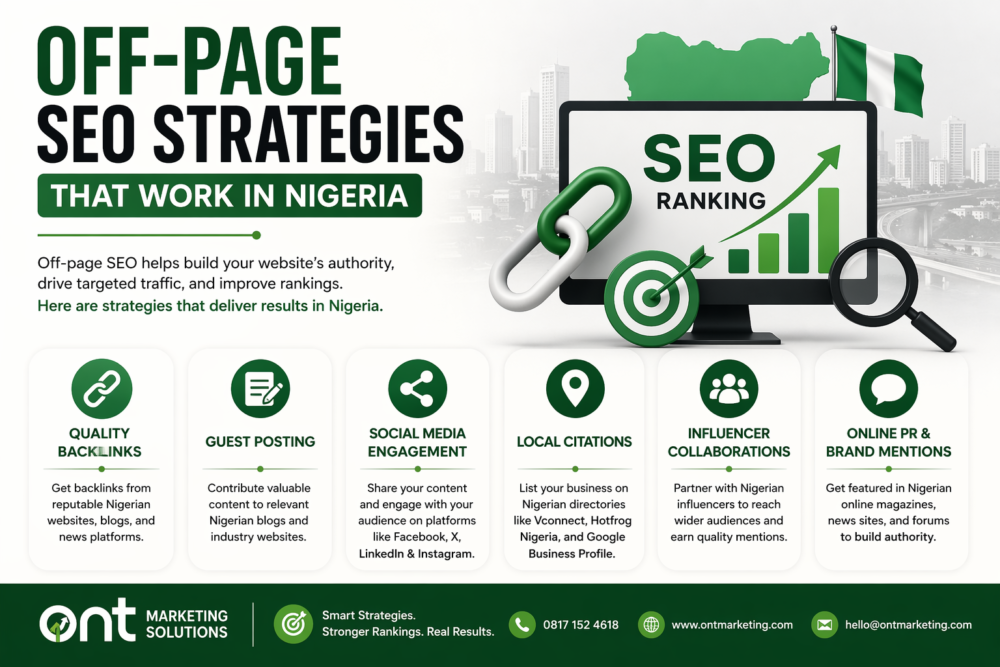
Audit Layer 3: Off-Page Authority
3.1: Domain Rating and Backlink Profile
Check your domain’s authority at ahrefs.com/website-authority-checker (free) or moz.com/domain-analysis (free). Key metrics to record: Domain Rating (Ahrefs) or Domain Authority (Moz), Total Referring Domains (unique sites linking to you), Total Backlinks, and any ‘Toxic’ or ‘Spammy’ link alerts.
Compare these metrics against the top 3-5 competitors ranking for your primary target keywords. The gap between your domain authority and your target competitors’ domain authority tells you the timeline for achieving rankings.
3.2: Backlink Quality Distribution
In Ahrefs or Moz, review your referring domains by domain rating. What proportion of your links come from DR 30+ domains? For most Nigerian commercial keywords, you need at least 20-30% of referring domains to be DR 30+ to compete for first-page positions.
Identify any potentially toxic links — links from clearly spammy sites, link farms, gambling networks, or adult content. Create a disavow file for Clearly toxic links using Google’s Disavow tool in Search Console.
3.3: NAP Consistency Audit
Search Google for your business name in quotes, your phone number, and your address. Document every listing found. Check for inconsistencies: business name variations, old phone numbers, old addresses.
Create a spreadsheet of every listing, current NAP, and required correction. NAP inconsistency is an active local ranking suppressor — Google loses confidence in your entity when your business information conflicts across sources.
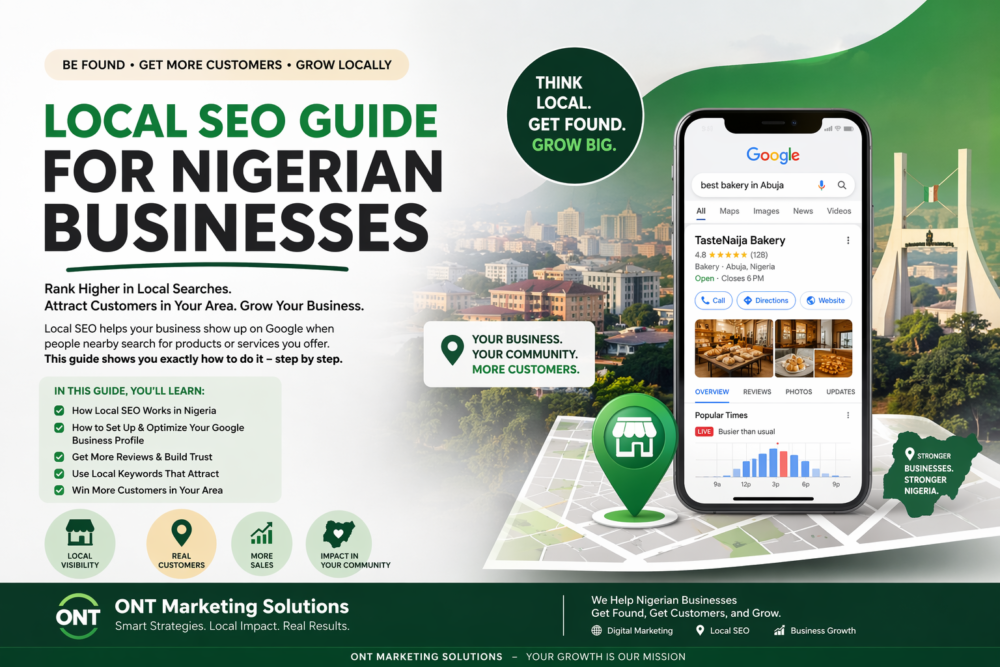
Audit Layer 4: Local SEO (For Location-Serving Businesses)
4.1: Google Business Profile Completeness Check
Log into business.google.com and check each field against this completeness checklist:
- Business name: exact legal name, no keyword stuffing
- Primary category: most specific accurate category (compare with top-ranked competitors)
- Secondary categories: 4-5 relevant additional categories
- Business description: 750 characters used, primary keyword present, city names included
- Services: every service listed individually with description
- Hours: accurate and complete including special hours
- Attributes: all applicable attributes selected
- Photos: minimum 15 uploaded, at least one of each type (exterior, interior, team, work samples)
- Posts: at least one post published in the last 7 days
- Q&A: minimum 5 self-seeded questions with answers
- Website URL: correct and linking to relevant service page
4.2: Local Search Position Audit
Search for your primary service + your city on Google mobile (use your target customer’s location if possible — or use Google’s ‘Set location’ feature in Search Tools). Note: Do you appear in the local pack? What position?
What does the top 3 GBP profiles look like versus yours — more reviews? More photos? More recent posts? More complete descriptions? This gap analysis tells you exactly where to focus your local SEO improvement effort.
4.3: Citation Consistency Check
Check VConnect, BusinessList.ng, ConnectNigeria, Finelib, Facebook, LinkedIn, and any industry directories. Are all listings using identical NAP format? Inconsistencies here directly suppress local pack rankings.
The SEO Audit Priority Matrix
After completing all four audit layers, you will have identified potentially dozens of issues. Not all are equal in impact. Prioritize fixes in this order:
Priority 1 — BLOCKING ISSUES (Fix Within 24 Hours)
Anything preventing Google from discovering, crawling, or indexing your site. robots.txt accidentally blocking Googlebot, sitewide no-index tags, missing SSL certificate, submitted sitemap with crawl errors. These override every other SEO effort — no amount of excellent content or backlinks matters if Google cannot access your pages.
Priority 2 — HIGH-IMPACT QUICK WINS (Fix Within 1-2 Weeks)
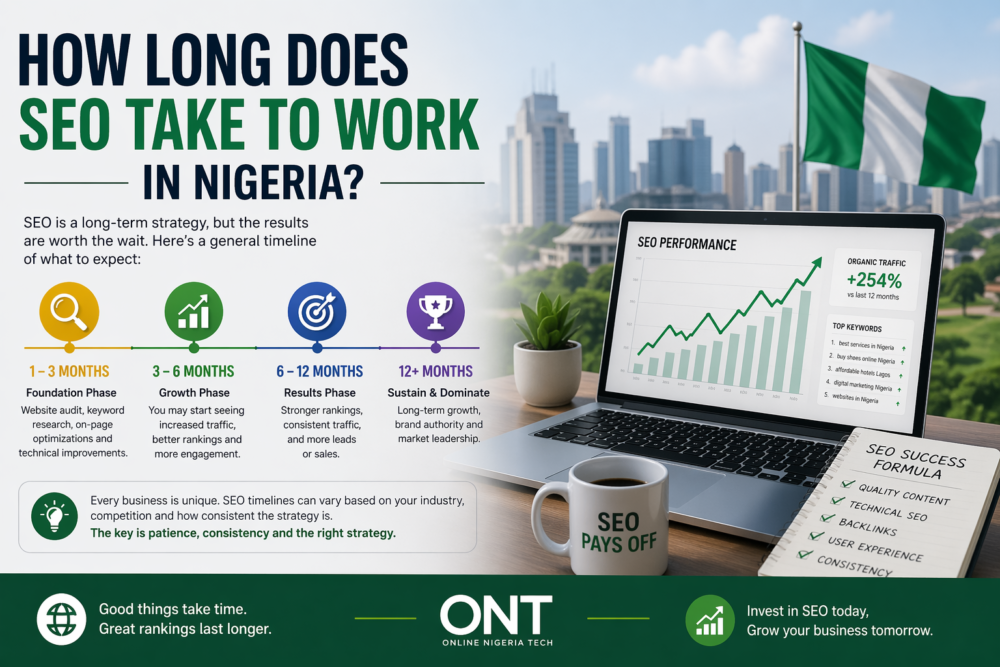
Missing title tags, duplicate title tags, absent meta descriptions, missing H1 tags, no schema markup, mobile usability failures, no LocalBusiness schema. These take 1-3 hours to fix per page and typically produce measurable ranking improvements within 2-4 weeks of Google recrawling the corrected pages.
Priority 3 — CONTENT IMPROVEMENTS (Fix Over 1-3 Months)
Thin pages under 500 words on important topics, keyword misalignment (wrong page targeting wrong keyword), outdated content on money pages, poor heading structure, unoptimised images. These require more time to execute but drive sustained organic traffic growth over 3-6 months.
Priority 4 — OFF-PAGE DEVELOPMENT (Ongoing Programme)
Low domain authority, insufficient referring domains, inconsistent NAP citations. These require a sustained 6-18 month programme of link building and citation development — running in parallel with technical and on-page fixes, not in sequence after them.
The Nigerian Website Audit Toolset (Free and Paid)
- Google Search Console (free): Indexation, coverage errors, performance data, Core Web Vitals from real users, manual actions — essential and irreplaceable
- Google PageSpeed Insights (free): Core Web Vitals lab data and specific performance recommendations — test every key page on mobile
- Screaming Frog SEO Spider (free up to 500 URLs): Crawls your site and extracts all technical data — title tags, meta descriptions, H1s, status codes, canonical tags, images
- Ahrefs Webmaster Tools (free): Backlink profile, domain rating, organic keyword rankings — free tier covers your own site fully
- MozBar (free Chrome extension): Instant domain authority and page authority readout while browsing — useful for quick competitor benchmarking during audits
- GTmetrix (free): Detailed page speed analysis with waterfall view — helps diagnose specific load time bottlenecks
- Mobile-Friendly Test by Google (free): Confirms mobile rendering and flags specific mobile usability issues
How Often Nigerian Businesses Should Conduct SEO Audits
The recommended audit frequency depends on your site’s size, how actively you are publishing and building, and your competitive environment:
- Full comprehensive audit: Every 6 months for most Nigerian businesses — this covers all four layers
- Technical spot check: Monthly — run Screaming Frog and check GSC Coverage and Core Web Vitals for any new errors
- Rankings monitoring: Weekly — use GSC or a rank tracker to monitor target keyword positions and catch early declines
- Post-update check: After any Google algorithm update announcement — check GSC for traffic changes and new errors
Conclusion
An SEO audit Nigeria is only valuable if it produces prioritized actions that your team actually executes. The goal is not a comprehensive documentation of everything wrong with your website as it is a prioritized list of specific fixes, ordered by impact, with clear ownership and timelines assigned.
The Nigerian websites that audited and executed systematically are the ones ranking today. The ones that audited, filed the report, and returned to their regular activities are still invisible on Google.
Use this framework as your systematic audit process. Complete each layer in sequence. Produce a priority action list from your findings. Execute Priority 1 fixes within 24 hours of the audit. Work through Priority 2 in the following two weeks.
Begin Priority 3 content improvements in month one. Launch your off-page programme in parallel. Revisit every 6 months.
| FREE AUDIT OFFER: ONT Marketing Solutions performs comprehensive SEO audits for Nigerian websites covering all four layers — technical, on-page, off-page, and local. We deliver a prioritized action report with exact fixes, timelines, and expected impact. Contact us at ontmarketingsolutions.com. |