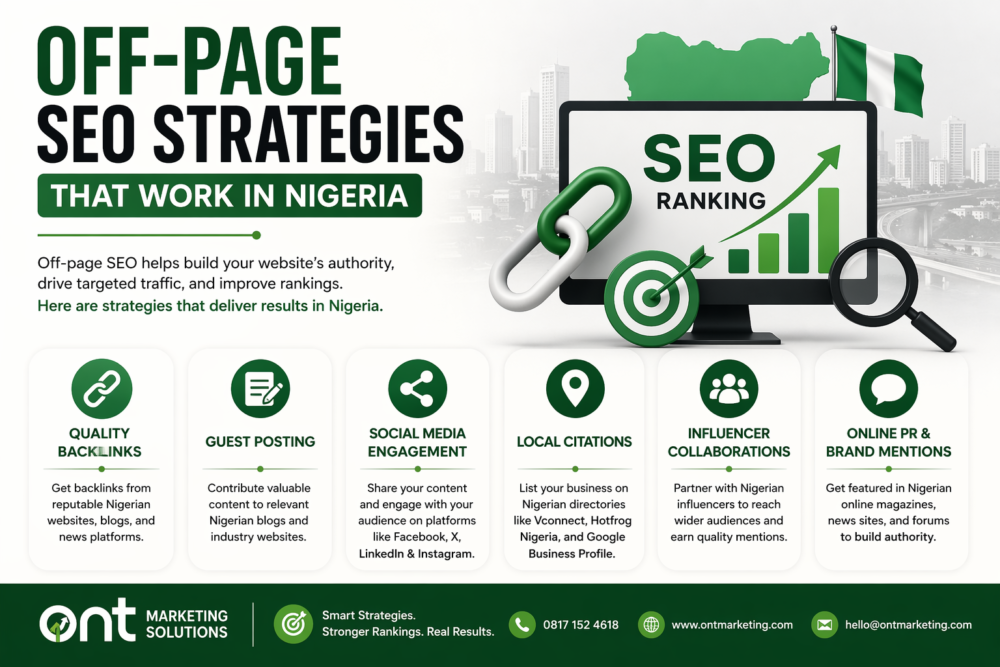
This article explains exactly why Nigerian websites fail at off-page SEO, what the Nigerian link ecosystem actually looks like, and the specific strategies tested on Nigerian websites in 2024 and 2025 that produce measurable domain authority growth and ranking improvements.
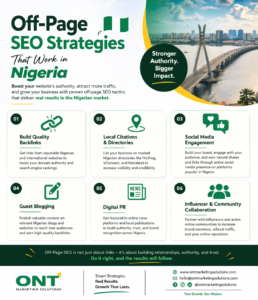
Off-page SEO strategies that work in Nigeria require a different playbook from what global guides teach. The Nigerian web has its own authority publications, its own directory infrastructure, its own PR landscape, and its own E-E-A-T (Experience, Expertise, Authoritativeness, Trustworthiness) evaluation context.
When you understand these specifics, you stop chasing links that do not move your rankings and start building the authority signals that Google actually weights for Nigerian-market searches.
| 50% | Off-page SEO factors account for approximately 50% of Google’s total ranking evaluation — meaning your website content alone can only ever address half the equation |
| 95% | of all web pages have zero backlinks according to Backlinko’s analysis of 14 billion pages — in Nigeria the proportion is even higher, meaning any systematic link building creates immediate competitive differentiation |
| 97%+ | of Nigerian internet searches go through Google — making Google’s specific off-page ranking signals the only off-page framework worth optimising for in this market |
Why Most Nigerian Websites Fail at Off-Page SEO
Before building an off-page strategy, you need to understand why the default approaches fail. After auditing dozens of Nigerian websites, the failure patterns are consistent:
Failure Pattern 1: Directory Submissions Without Strategy
Many Nigerian businesses believe that listing on VConnect, BusinessList.ng, and ConnectNigeria constitutes off-page SEO. These citations are valuable, but they are NAP consistency signals for local SEO, not domain authority builders. A website with 20 Nigerian directory listings but no editorially-earned backlinks has not built off-page authority. It has built a citation footprint.
Failure Pattern 2: Buying Links from Link Farms
The market for cheap backlinks in Nigeria is active and visible. Services promising ‘100 do-follow backlinks for ₦15,000’ exist across Nairaland, Instagram, and WhatsApp groups.
Every single one of these creates a toxic backlink profile that will either not move rankings at all or actively suppress them. Google’s 2024 and 2025 spam updates specifically targeted bulk link schemes. Any Nigerian website that purchased these links is carrying algorithmic dead weight.
Failure Pattern 3: Zero Authority Publication Presence
The highest-value off-page signal available to Nigerian businesses editorial mentions are links from TechCabal, BusinessDay Nigeria, Nairametrics, The Punch Online, or Stears which requires relationship building and genuine news worthiness.
Most Nigerian businesses never attempt this because they do not know it is the highest-leverage activity in Nigerian off-page SEO. One link from BusinessDay carries more domain authority than 200 directory submissions.
Failure Pattern 4: Social Shares Confused with Links
Social media shares, WhatsApp broadcasts, and Instagram story mentions are not backlinks. They do not directly contribute to your domain authority. This misunderstanding leads Nigerian businesses to invest heavily in social promotion while ignoring the link building that actually moves organic rankings.
The Nigerian Authority Publication Landscape
To build off-page SEO in Nigeria that produces rankings, you need to know which publications carry genuine domain authority. Here is the Nigerian press ecosystem ranked by SEO value:
Tier 1: Maximum Authority (DR 60+)
TechCabal (techcabal.com) — Nigeria’s leading technology publication, active editorial team, high domain authority, covers Nigerian startups and digital businesses.
BusinessDay (businessday.ng) — Major Nigerian business newspaper, very high domain authority, covers industry trends and business data.
Nairametrics (nairametrics.com) — Financial news and analysis, high authority, covers Nigerian economic and business data.
The Punch Online (punchng.com) — Established Nigerian newspaper with strong domain authority.
Vanguard (vanguardngr.com) — Major newspaper with high authority and significant online readership.
Tier 2: Strong Authority (DR 40-60)
Stears (stears.co) — Premium Nigerian business intelligence publication. Guardian Nigeria (guardian.ng) — Established newspaper, moderate-high authority.
Premium Times (premiumtimesng.com) — News publication with strong authority. ThisDay (thisdaylive.com) — Business and news publication. Ventures Africa (venturesafrica.com) — Covers African business and tech.
Tier 3: Niche Authority
Industry-specific publications: AgriNigeria for agriculture, Nigerian Bulletin for general news, Tekedia for tech policy, StartupBlink for startup ecosystems. These carry lower domain authority but strong topical relevance which is increasingly important as Google’s Helpful Content system weights topical authority alongside link authority.
Strategy 1: Digital PR — The Highest-Leverage Off-Page Tactic
A single editorial mention with a link from BusinessDay or TechCabal is worth more for your off-page SEO than anything else you can do in the Nigerian market. This is not opinion as it is measurable in domain rating uplift. The reason most Nigerian businesses never earn these links is that they pitch incorrectly or never pitch at all.
The Nigerian Digital PR Formula
The formula for earning editorial mentions from Nigerian authority publications follows a consistent pattern: create something genuinely newsworthy, frame it as a story that serves the publication’s audience, and pitch to the right person with the right angle. Here is what actually works:
- Create original Nigerian market data: Run a survey of 50-200 Nigerian businesses or consumers on a topic relevant to your industry. ‘67% of Lagos SMEs have never created a Google Business Profile’ is a story TechCabal will cover. ‘We launch new service’ is not.
- Write a case study with specific numbers: ‘How a Kano fashion business grew organic traffic 340% in 8 months using content marketing’. Real numbers, real business, real outcome. Nigerian journalists respond to specificity.
- Create a data report: Compile publicly available data about your Nigerian industry into a summary report with original analysis. These become reference documents that earn ongoing citations from articles in your niche.
- Take a genuine contrarian position: A well-reasoned opinion piece challenging a common assumption in your Nigerian industry will attract engagement and editorial coverage. The keyword is well-reasoned as Nigerian tech media has seen enough hot takes to recognize unsupported contrarianism.
- Comment on breaking news as an expert: When relevant news breaks in your Nigerian industry, be available to journalists as a source. This requires proactive relationship building following Nigerian tech and business journalists on LinkedIn and X before you need them.
Strategy 2: The Link Building Hierarchy for Nigerian Websites
Not all links are equal. Building an off-page strategy without understanding the hierarchy of link value is why most Nigerian link building campaigns produce nothing. Here is the value hierarchy, highest to lowest, for Nigerian websites:
Tier 1: Editorially Earned Links (Most Valuable)
These are links that a journalist, blogger, or content creator chose to include because your content deserved it and not because you asked, paid, or exchanged for it. The mechanism: create genuinely excellent, original content on your Nigerian site that becomes a reference source.
Data reports, original research, comprehensive guides, and free tools earn these naturally. The Nigerian SEO content desert means that genuinely excellent content earns editorial links faster here than in mature Western markets.
Tier 2: Digital PR and Press Links
Links earned through proactive media outreach, as described above. These require effort but produce the highest domain authority uplift per link of any acquirable link type.
Tier 3: Guest Posts on Genuine Publications
Guest posting still works in 2026 but only on publications with real editorial standards, real traffic, and audiences that are not primarily there to consume guest posts.
In Nigeria, this means writing for TechCabal, BusinessDay’s guest section, Stears, or established industry blogs. It means writing content of the same quality you would write for your own site. Guest posting as a link exchange scheme on Nigerian article farm networks is worthless and risky.
Tier 4: Resource Page and Broken Link Building
Find pages on Nigerian authority websites that link to dead resources in your topic area. Create better content, contact the site owner, propose a replacement.
This works because you are solving a problem for the site owner and a broken link hurts their user experience while earning a contextual backlink. Nigerian university websites, government departments, and established industry associations frequently have outdated resource pages that represent link building opportunities.
Tier 5: Nigerian Directory Citations
Structured citations on Nigerian business directories — VConnect, BusinessList.ng, ConnectNigeria, Finelib, CorporateNigeria provide NAP consistency signals that support local SEO rather than pure domain authority. They are not optional for local businesses, but they are not link building in the domain authority sense.
Strategy 3: E-E-A-T Building for Nigerian Websites
Google’s E-E-A-T framework — Experience, Expertise, Authoritativeness, Trustworthiness is evaluated almost entirely through off-page signals. The March 2026 Core Update specifically reinforced E-E-A-T signals as a primary differentiator between similar-quality pages. For Nigerian businesses, here is what building E-E-A-T looks like in practice:
Experience Signals
Demonstrate real-world experience relevant to your topic area through case studies, client results with specific numbers, documented project histories, and before/after content that shows measurable outcomes. Nigerian businesses that publish detailed client case studies with named businesses and verified results build E-E-A-T evidence that generic agencies cannot replicate.
Expertise Signals
Named authorship with verifiable credentials. If your SEO content is authored by someone with a provable history in digital marketing, that matters to Google’s Quality Raters.
LinkedIn profiles, published articles, conference speaking credits, and professional association memberships all contribute to author entity establishment. Nigerian SEO professionals who have built public profiles on TechCabal, BusinessDay, or industry publications create expertise signals that strengthen every page they publish.
Authoritativeness Signals
These are primarily the editorial links and brand mentions discussed above. An authoritative Nigerian business is one that other authoritative Nigerian sources reference.
Being cited in TechCabal as an expert source is an authoritativeness signal. Being listed as a top 10 Nigerian SEO agency in an editorial article is an authoritativeness signal. Having your original data cited in multiple Nigerian publications is an authoritativeness signal.
Trustworthiness Signals
Trust signals are partially on-site (SSL, privacy policy, clear contact information, named team members, business registration number) and partially off-site (consistent NAP across directories, positive review profiles, absence of negative press, active social media presence that confirms the business is real and active).
For Nigerian businesses, the trustworthiness layer is particularly important because Nigerian consumers are conditioned by online fraud experiences to distrust websites that cannot be verified.
Strategy 4: AI Citation Building — The 2026 Off-Page Frontier
The newest dimension of Nigerian off-page SEO is optimising for citation in AI-generated search results. BrightLocal’s 2026 Local Consumer Review Survey found that 45% of consumers now use ChatGPT or other AI tools for local business recommendations up from just 6% in 2025.
When a Nigerian business owner asks ChatGPT ‘what is the best SEO agency in Lagos,’ the AI draws on its training data and live web search capabilities to generate an answer. Appearing in that answer requires the same off-page authority that drives traditional search visibility but with additional emphasis on structured, consistent information across the web.
AI Citation Optimisation Checklist
- Publish original Nigerian market research that AI models will train on and cite
- Ensure your Wikipedia knowledge graph presence — company Wikipedia pages or mentions in Wikipedia articles related to your industry
- Maintain schema markup that makes your entity machine-readable: name, address, founding date, description, same as links
- Get featured in ‘best of’ editorial lists from authoritative Nigerian publications
- Ensure your Google Business Profile description and website About page use consistent, accurate, keyword-rich entity descriptions
- Build press coverage from publications that AI crawlers actively index as authoritative sources
Strategy 5: Podcast and Video Off-Page Authority
Being a guest on Nigerian or African business podcasts produces three off-page benefits that most practitioners miss. First, podcast show notes typically include a link to the guest’s website editorially included, topically relevant, from a real website with a real audience. Second, podcast mentions constitute unlinked brand citations that Google’s quality evaluation systems recognise.
Third, audio and video content syndicated on YouTube and podcast platforms creates entity presence across multiple discovery surfaces. Nigerian podcasts in the business, entrepreneurship, and technology space including shows on Spotify Nigeria, Apple Podcasts, and YouTube are active and growing, creating genuine opportunity for authority guest appearances.
Strategy 6: Nigerian Community-Driven Link Building
Nigerian online communities is the StartupList Africa ecosystem, TechCabal’s comment community, Nairaland’s entrepreneurship section, Lagos Business School alumni networks, and WhatsApp business groups that generate unlinked mentions that contribute to brand entity recognition.
More specifically, genuine participation in these communities creates relationship capital that eventually converts to link opportunities: the community member who appreciates your contributions becomes the journalist who quotes you, the blogger who references your guide, or the association that lists you as a resource.
Measuring Off-Page SEO Progress for Nigerian Websites
The metrics that actually tell you whether your off-page SEO is working:
- Domain Rating (Ahrefs) or Domain Authority (Moz): Track monthly. Meaningful growth is 2-5 DR points per quarter for a new-to-medium Nigerian website actively building off-page authority.
- Referring Domains Count: The number of unique domains linking to you — more important than total backlinks. Google values source diversity over link volume.
- Quality Distribution: What percentage of your backlinks come from domains with DR 30+? For Nigerian websites targeting competitive commercial keywords, at least 30% of referring domains should be DR 30+.
- Brand Search Volume: Track branded keyword searches in Google Search Console. Growing brand search volume indicates growing off-page brand recognition that feeds into Google’s brand signal assessment.
- AI Visibility Spot Check: Monthly manual check — query ChatGPT, Perplexity, and Google Gemini for ‘best [your service] in [your city]’ and track whether your business appears.
- Press Mention Count: Monthly count of editorial mentions across Nigerian publications tracked via Google Alerts set to your brand name and key personnel names.
The 90-Day Off-Page SEO Sprint for Nigerian Websites
A realistic, prioritised 90-day programme for Nigerian businesses starting from a weak off-page position:
- Days 1-14: Audit existing backlink profile in Ahrefs or Moz free tools. Disavow clearly toxic links. Set up Google Alerts for brand name and key personnel.
- Days 15-30: Submit to all Tier 1 and Tier 2 Nigerian directories with consistent NAP. Build LinkedIn author presence for all content creators on your team.
- Days 31-45: Create your first linkable asset — an original Nigerian market data piece, a comprehensive guide, or a free tool. Launch outreach to 5 Nigerian industry journalists who cover your topic.
- Days 46-60: Publish 3 genuine guest contributions on Nigerian authority publications in your niche. Apply for 2-3 Nigerian podcast guest appearances.
- Days 61-75: Follow up on all outreach. Track domain rating change. Identify broken link building opportunities on Nigerian authority sites.
- Days 76-90: Review: which content earned natural inbound links? Double down. Which outreach produced relationships? Deepen them. Plan next quarter’s linkable asset.
Conclusion
Off-page SEO strategies that work in Nigeria are not quick fixes or bulk submission schemes. They are a long-term authority-building programme that requires consistent investment over 6-18 months before the full compounding value is realized.
The businesses that commit to this programme is creating genuinely excellent linkable content, building Nigerian press relationships, earning editorial mentions from authority publications, and maintaining consistent E-E-A-T signals to build off-page authority profiles that become increasingly difficult for competitors to displace.
The Nigerian market’s off-page SEO landscape is underdeveloped. Most Nigerian business websites have domain ratings below 20 and referring domain counts below 10. This means that even modest, systematic off-page SEO effort produces rankings that look remarkable against the competition.
The question is not whether off-page SEO strategies work in Nigeria but is that they work more dramatically here than in any mature Western market. The question is whether your Nigerian business will be the one that builds the authority while competitors wait.
| FREE RESOURCE: ONT Marketing Solutions offers a free off-page SEO audit for Nigerian businesses — we analyze your current backlink profile, identify toxic links, and map your link building opportunities. Contact us at ontmarketingsolutions.com. |